
Tomato Curry Recipe (Tamatar Curry)
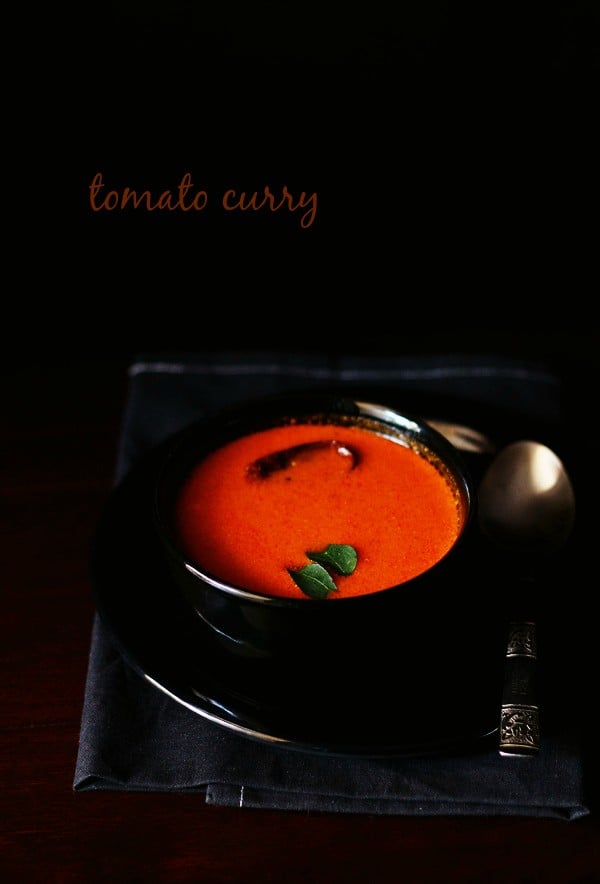
This Tomato Curry recipe is a vibrant coastal dish from Goa made with fresh tomatoes, and a flavorful masala paste of onions, tomatoes, coconut, garlic, coriander seeds and dried red chillies. It cooks into a mildly tangy, aromatic curry, light yet very tasty. The coconut and spices balance the tomato tanginess. Serve it with steamed rice, jeera rice or chapati for a comforting, easy meal.
How I Make Tomato Curry
This Tomato Curry recipe is a family recipe and a special one from my mother. It has the coastal flavors of ground spices and coconut, and I have been making it for many years now.
When I don’t have other vegetables at home, I make this Tomato Curry. Tomatoes are always available in my kitchen, so it becomes an easy option.
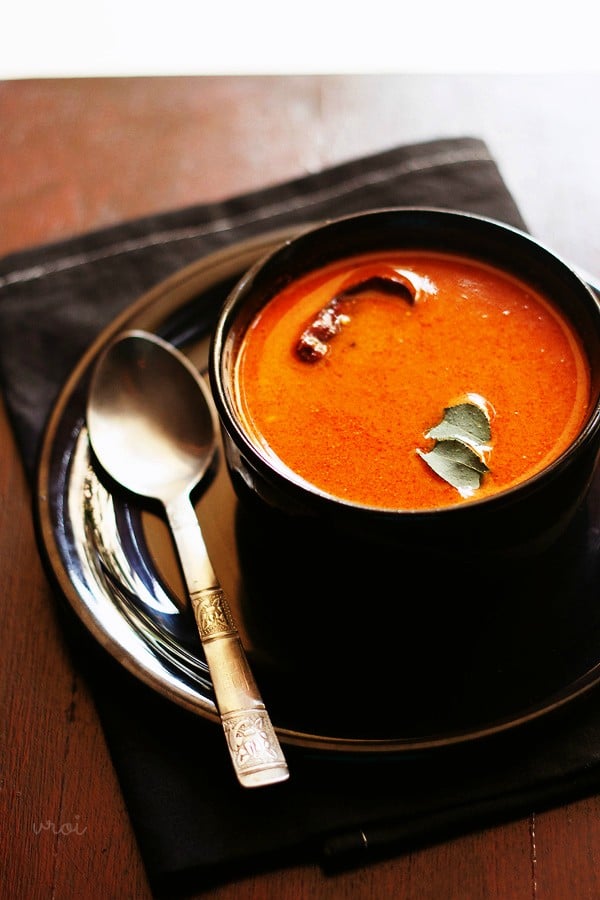
Two more Goan curries that I make without vegetables is this coconut based spiced Sorak Curry and this tangy Solkadhi.
Curry and rice is a meal I have grown up with. So, whenever I prepare this Tomato Curry, I pair it with steamed rice and I don’t really need anything else to go with this combination. What’s more is that this curry packs a punch of flavors.
This Tomato Curry recipe is similar to the way I make a Goan Curry with mix vegetables. The main difference is that the tomatoes add a slight element of tanginess in this recipe.
The curry made with tomatoes does not have cumin in the masala paste but is added later. The subtle sweetness of the coconut and the heat of spices like red chillies beautifully balances the tanginess of the tomatoes.
I like this curry mild, and not hot or spicy. Hence, I always use dried Kashmiri red chilies which are mildly spicy and basically impart a bright red color to the curry.
Depending on the type of dried red chilies, the taste and flavor of the curry changes from being a bit smoky to hot.
You can also add about a tablespoon of chopped fresh coriander leaves while grinding the masala paste. This brings in a fresh herby touch to the curry recipe.
Explore More Tomato Recipes
Step-by-Step Tomato Curry Recipe
These step-by-step photos will help you follow the recipe smoothly. Start by making the base paste that gives the curry its flavor.
Make Tomato, Coconut & Spices Paste
1. Take all the ingredients to be ground in a wet grinder jar or a sturdy blender:
- ½ cup tightly packed chopped tomatoes
- 4 to 5 dried Kashmiri red chilies, broken and seeds removed
- 2 to 3 small to medium garlic, sliced
- ⅔ cup tightly packed grated fresh coconut
- 2 teaspoons coriander seeds
- 1.5 tablespoons chopped onions
- 5 whole black peppercorns, optional
- ¼ teaspoon turmeric powder
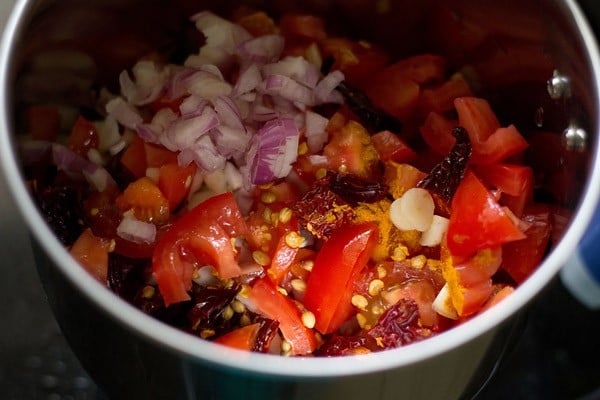
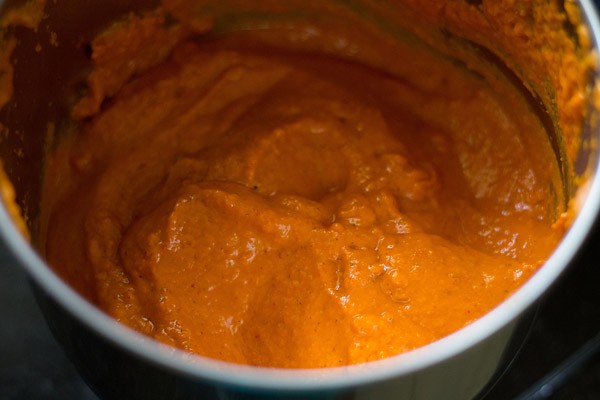
2. Add 3 tablespoons water and grind to a smooth paste. There should be no small chunks or pieces of coconut in the paste. Keep aside.
Make Tomato Curry
3. Heat 2 tablespoons oil in a pan or pot. Add 1 teaspoon mustard seeds and let them crackle. Then, add 1 teaspoon cumin seeds and fry till the crackle and change color.
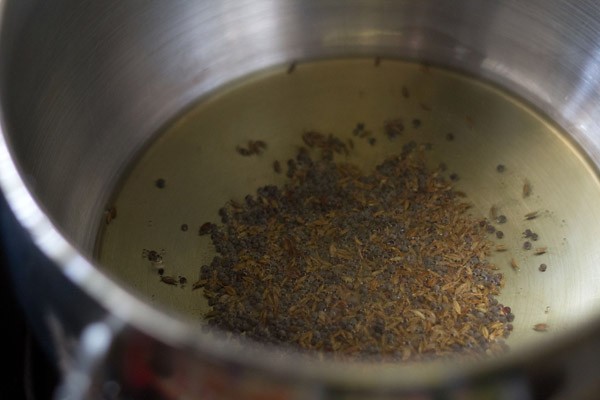
4. Add 1 tablespoon chopped onions or shallots and sauté till translucent on medium-low heat.
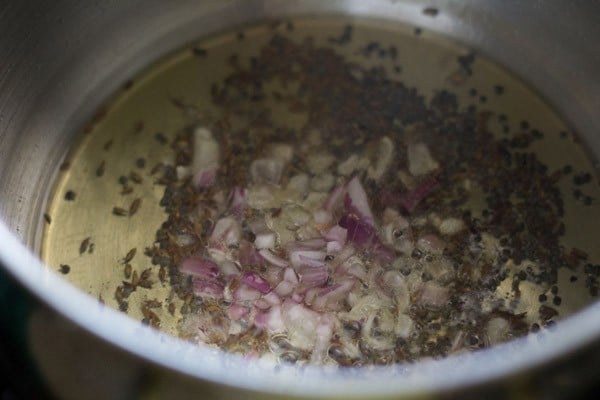
5. Then, add 6 to 7 curry leaves, 2 dried red chilies (seeds removed) and 1 pinch asafoetida (hing). Stir to mix.
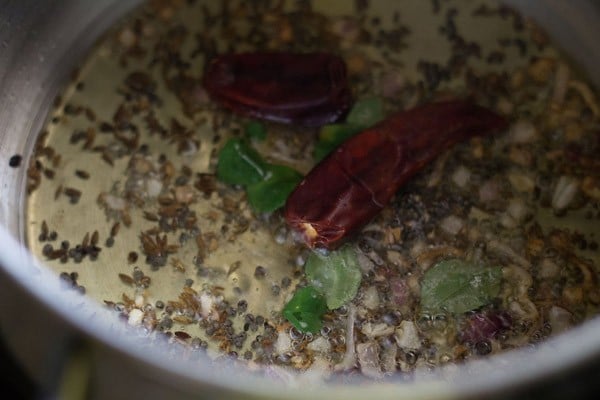
6. Add ½ to ⅓ cup chopped tomatoes.
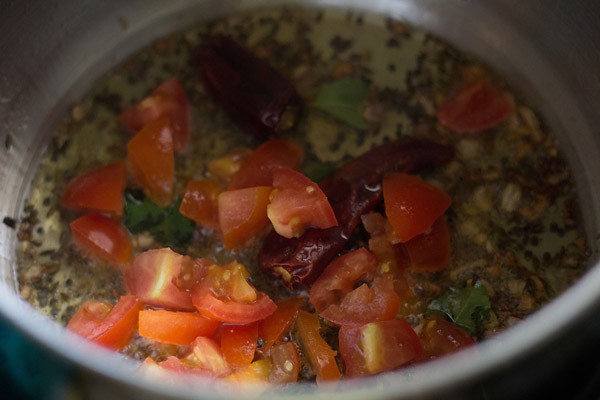
7. Sauté the tomatoes for 3 minutes on low heat.
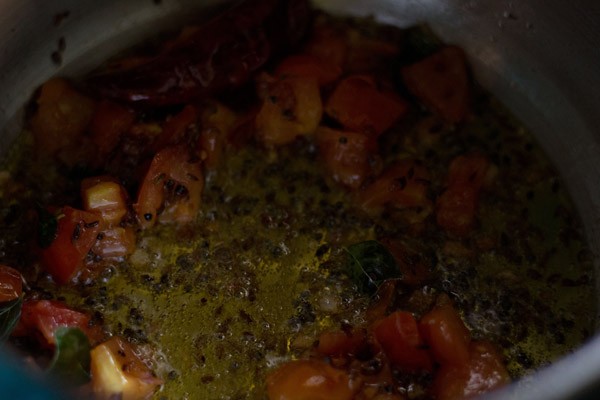
8. Add the prepared tomato-coconut-spice paste.
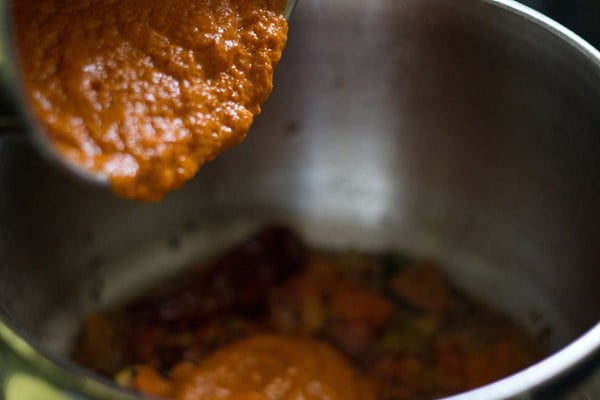
9. Stir and sauté for 1 to 2 minutes on low heat.
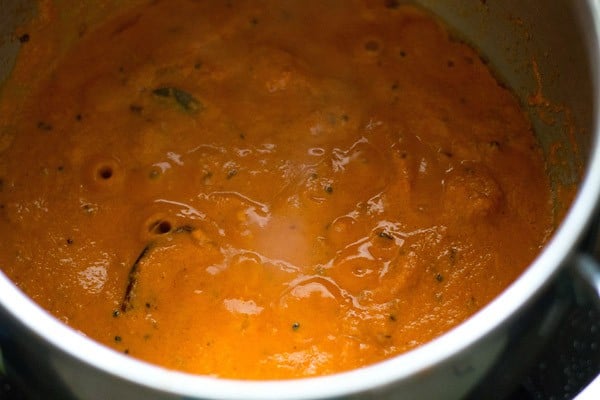
10. Add 3 cups water.
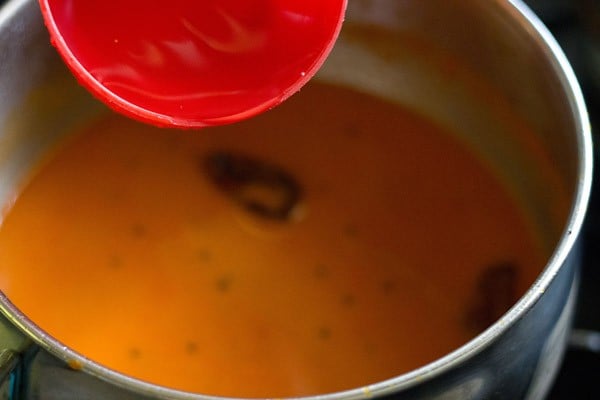
11. Season with salt as required.
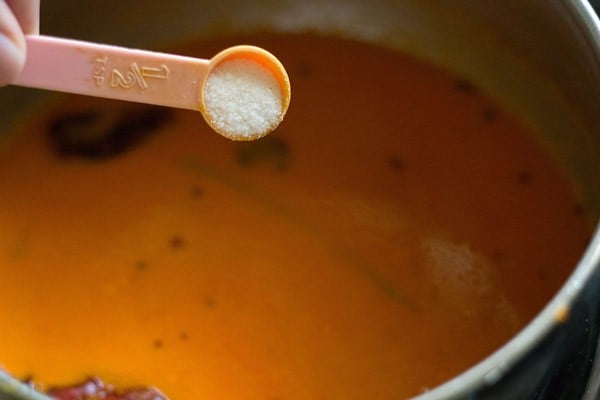
12. Bring to a complete boil first without a lid. Then, simmer the curry on low heat, again without a lid.
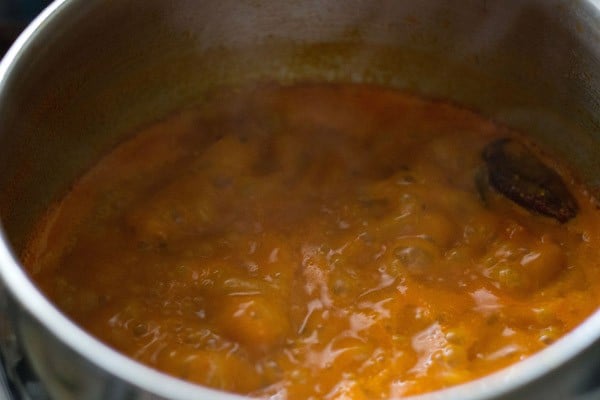
13. Simmer till you see oil floating on top of the curry. About 12 to 15 minutes on low heat after the first boil. Stir at intervals.
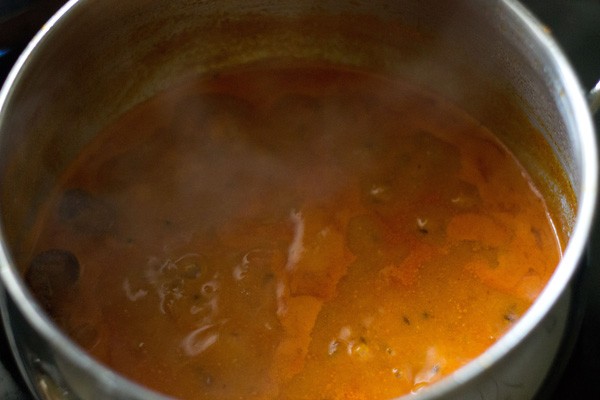
14. Serve the Tomato Curry hot with steamed rice, Jeera Rice or chapati.
Like most coconut-based curries, this curry also goes well with steaming cooked rice. Accompany a light side vegetable salad like Khamang Kakdi (Maharashtrian Cucumber Salad) or a pickle with it.
You can also have some stir-fried or pan-fried vegetable dish, by the side like Brinjal Fry, Yam Fry, Mushroom Fry or Capsicum Fry.
Dassana’s Recipe Tips
- Make sure the tomatoes are ripe and juicy, as they give the curry its balanced tang.
- If the curry tastes too tangy, add a small pinch of jaggery to round the flavors.
- You can add about 1 tablespoon of chopped coriander leaves while grinding the masala paste for extra freshness.
- If the dried red chilies are very hot, reduce the quantity. For a bright orange or red curry, use Kashmiri red chilies.
- Use any neutral-flavoured oil, or coconut oil if you prefer a light coastal touch.
- For a slightly thicker curry, reduce the amount of water while simmering.
Asked & Answered
Can I use coconut cream as an alternative to fresh coconut?
Yes, you can definitely use coconut cream in place of fresh coconut.
Do I have to roast or sauté the ingredients before grinding?
Not really. You don’t have to roast or sauté the ingredients before grinding. Also, because this is a Goan delicacy and in Goan cuisine, the ingredients are not roasted. They are ground fresh.
How can I avoid splashing of the curry when it is simmering without the lid?
The best way to avoid it is to use a deep pot or pan to cook and simmer the curry. You also have to make sure to keep the heat to a low or medium.
Can I use cashews in place of coconut?
No. I wouldn’t recommend you adding cashews instead of coconut in this curry as then the flavor of this curry will change completely. With cashews, it will taste more like a Punjabi style curry than a Goan one.
Step by Step Photo Guide Above
Tomato Curry Recipe
Ingredients
For the Tomato-Spices Paste
- ½ cup chopped tomatoes – tightly packed
- ⅔ cup grated fresh coconut – tightly packed, or ½ cup tightly packed chopped fresh coconut
- 2 to 3 garlic cloves – small to medium-sized
- 2 teaspoons coriander seeds
- 1.5 tablespoons chopped onions or shallots
- 4 to 5 kashmiri dry red chilies – broken and seeds removed if you prefer
- 5 whole black pepper – optional
- ¼ teaspoon turmeric powder
- 3 tablespoons water for grinding the masala paste
Remaining Ingredients
- 2 tablespoons oil
- 1 teaspoon mustard seeds – black
- 1 teaspoon cumin seeds
- 1 tablespoon chopped onions
- 6 to 7 curry leaves
- 2 dry red chilies – stalks removed
- 1 pinch asafoetida (hing), optional
- ½ to ⅓ cup chopped tomatoes – for sautéing
- 3 cups water or as required
- salt as required
- 1 to 2 tablespoons chopped coriander leaves for garnish, optional
Instructions
Making Tomato-Spices Paste
- Rinse and chop the onions, garlic and tomatoes.
- Break the dry red chilies and deseed them if you prefer.
- Grate the coconut and keep aside. You can also chop the coconut into small pieces.
- Take all the ingredients to be ground in a wet grinder jar or a sturdy blender – chopped tomatoes, broken red chilies, garlic, coconut, coriander seeds, chopped onion, whole black pepper and turmeric powder.
- Add 3 tablespoons of water and grind to a smooth fine paste. There should be no small chunks or pieces of coconut in the masala paste. Keep the ground paste aside.
Making Tomato Curry
- Heat oil in a pan or pot. Add mustard seeds and crackle them.
- Then add cumin seeds. Fry till they splutter. Add onions and sauté stirring often till translucent
- Then add curry leaves, dry red chilies and asafoetida(hing).
- Stir and then add tomatoes. Sauté them for 3 minutes.
- Add the ground masala paste and sauté for 1 to 2 mins, stirring often.
- Next add 3 cups water. Season with salt as needed.
- Bring to a complete boil first without a lid. Then simmer the curry on a low heat, again without a lid. Stir the curry at intervals.
- Simmer till you see oil floating on top of the curry. About 12 to 15 minutes on a low heat after the first boil.
- Garnish with coriander leaves and serve Tomato Curry hot with steamed rice or chapathi or jeera rice.
Dassana’s Notes
- You can add about 1 tablespoon of chopped coriander leaves while grinding the masala paste.
- If the dried red chilies are hot or pungent, then reduce the quantity.
- For a bright orange or red colored curry, I suggest to use dried Kashmiri red chilies.
- Use any neutral flavored oil. You can also use coconut oil.
- For a slight thicker consistency in the Tomato Curry, reduce the quantity of water.
Nutrition
Tomato Curry recipe from the blog archives was first published on September 2014.
Hi, I’ve been cooking from your blog since 2013 and love it. I’m going to start trying some recipes like this one that has coconut. Can I use coconut powder if that’s all I have? If so, how much?
Hi Nicole, good to know and thanks for sharing that. Yes of course, in any recipe that has fresh coconut, you can easily substitute with coconut powder or unsweetened desiccated coconut. In this recipe you can add about ⅓ cup of coconut powder.
Thank you! Off to cook 🙂
Welcome and I hope you liked the dish.
Hi
This is my favorite blog for recipes.
I tried this recipe today.
It came out great .
Thanks a lot for ur recipe posts.
Welcome Aruna. Thanks for your positive feedback for blog.
Hi Dassana…i tried this today. .its awesome like ur other recipes..thank u. N yes i am loving all ur videos.
Welcome Richa. Thanks for sharing positive feedback.
The most perfect recipe ever !!!! Thanks a lot…
thankyou so much sonam 🙂
Hi! I’m trying this recipe for the very first time. And the dish looks yum and when I and my family taste it,it would be yum too.
Before grinding the ingredients,do they need to be roasted or saúteed or something?
thanks. no need to roast the ingredients. in goan cuisine, the ingredients are not roasted and ground fresh.
Ah okay! Thanks a lot! The dish came out yum! Thanks for sharing a lovely recipe!
thanks for letting me know janani 🙂
Hi. I have tried a couple of recipes from your site, and they have turned out absolutely fab.
I have a general doubt though. When we simmer gravy or curry without the lid, the curry tends to splash around. Any tip u can suggest to reduce this mess.
Thanks a lot!
its best to use a deep pan or pot, to simmer gravy or curry. also keep on a low or medium flame.
Tried this out tonight ,it was really tasty! Your website has taught me to cook good, vegetarian Indian Food, and I am so happy for this! I also made some of your paneer recipes and Aloo Palak! Thank you very much! Greetings from Norway!
Oscar
welcome oscar. nice to know this. thanks for sharing your positive feedback.
Hii dassana,
Can I use coconut cream instead of fresh coconut, as fresh coconut is not available right now.
Thanks
welcome ràsika. yes you can use.
It was awesome all my relatives ate like anything thanks
welcome rashmika
I do not have a grinder jar, but this sounds amazing! Can I use a blender or a food processor? I have both of those… thank you!
welcome molly. you can use any of them. but they should be powerful. because grinding coconut is tough.
Hi reading your recipes since yesterday. Amazing – so extensive n intensive. Got all I wanted except VEG Parsi Curry which has coconut, raw peanuts, dahlia (channa) til, khus khus, etc. Could u please post the recipe. Thank you. Kashmira
PL first recipe site I enjoyed reading n told my sisters n friends about.
thanks kashmira. i have added your request in the recipe request sheet. will take some time to add the recipe. also convey my thanks to your sisters and friends.
Hi Dassana, your recipes are too good
yet simple to make. I tried most of them n just loved making them.Thanks.
I am a goan too .
good to know ashwini. thanks for the feedback too.
Garam masala
which is the best brand of garam masala.
best is to make homemade garam masala.
I like all dishes u have mentioned here… U really make it simple and easy for us… Right now I m looking for fish curry Goa style, also know as Maashaychi kadhi or Maashacha Kalvan. Please if u can put its recipe here. I have always tried to make it but landed up with spoiling the dish… 🙂
thanks manjiri. you can try the following goan curry recipes and replace fish with the veggies. but the fish just has to added to the curry and cooked.
1 – https://www.vegrecipesofindia.com/vegetable-curry-recipe-goan-vegetable-curry/
2 – https://www.vegrecipesofindia.com/mushroom-caldin/
This looks delicious. Is there another name or substitute for asafoetida? I can’t find it anywhere.
Thanks 🙂
thanks. asafoetida is called as ‘hing’ in hindi. generally onions and garlic are used as substitutes for asafoetida.
Hi dassana, I made this curry a couple of weeks ago and it was lovely. My husband a proper Sikh and avid meat eater was loving this veg dish. I did feel though that the curry tasted even better the following day! Thanks for sharing !
welcome neetu. glad to know this. thats a big compliment.
Hello Dassana,
Today i cooked tomato curry. it tastes good but:
1) its very watery.
2) my paste was not as smooth as u had mentioned…b’coz i did not have fresh coconut, i used dry one…so i can feel coconut in the gravy…can i use cashew nuts in place of coconut next time…plz tell me how to make lil more thick gravy…
the curry is not watery. if you would have simmered more, the watery consistency would have reduced. for dry coconut, you will have to grind really well. also adding warm water while grinding dry coconut helps. i think you use dry coconut slivers or pieces. dry coconut slivers or pieces gives a much intense coconut taste and flavor, then fresh coconut or coconut powder. cahshew nuts will change the whole taste of the curry. it will be like a punjabi curry.
Thank you so much…
You are the best.. very soon i am going to be a married and your website and recipe helps me a lot to cook and make excellent recipe…
welcome pooja. wishing you a happy married life. glad to know that you liked the website and recipes.
Can I use crushed coconut(dried)?
dried coconut will give a different flavor and taste. but you can still try this curry. soak the dry coconut in hot water for 30 minutes. just about cover the coconut with water. this softens then and then while grinding you add both the coconut and water.
Your recipe says 2tbsp oil but in the image the oil seems much more that 2 tbsp. Just saying.
sujay, its 2 tbsp oil only. could be photo illusion.
Any particular reason why the text is black background and grey text? Just curious, I think it is good for the eyes though I would like white text in black background better.
teresa, no particular reason. its the default color of the software which shows the recipe instructions.