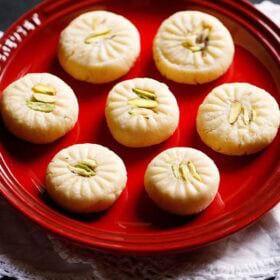
Peda Recipe | Milk Peda
This easy Peda recipe is made with khoya (mawa), sugar, milk and cardamom, and garnished with pistachios or almonds. Also known as Doodh Peda or Milk Peda, this classic Indian sweet is quick to make for festivals and celebrations.
Servings: 12 peda
Calories: 100kcal
Ingredients
- 200 to 205 grams (1 cup) Khoya – grated
- ½ cup (125 grams) sugar – or add as required
- ½ teaspoon cardamom powder
- 2 to 3 tablespoons milk
- 3 to 4 pistachios or almonds, slivered or thinly sliced
Instructions
Make Peda Mixture
- Grate the khoya and add it to a heavy, thick-bottomed kadai or skillet. You will need 1 tightly packed cup (200 to 205 grams) grated khoya.
- Add the sugar and cardamom powder.
- Place the pan on the stovetop over low heat. Mix the khoya, sugar and cardamom thoroughly.
- Add 2 to 3 tablespoons milk and mix well.
- As the sugar melts, the mixture will loosen and become more liquid.
- Continue to cook on low heat, stirring continuously with a spatula. Do not stop stirring, as the khoya mixture can stick to the bottom of the pan, brown or burn.
- As it cooks, the mixture will become creamy and begin to bubble.
- Continue stirring and cooking on low heat until the mixture thickens, condenses and begins to leave the sides of the pan.
- Immediately transfer the hot peda mixture to a steel plate or tray. It should be thick but still soft enough to spread slightly when transferred.
- Do not overcook the mixture. If cooked for too long, the peda can become firm or chewy after cooling.
- Let the mixture cool at room temperature until it is lukewarm and comfortable enough to handle.
Make Milk Peda
- Take small portions of the lukewarm mixture and roll them between your palms into smooth, small to medium-sized balls.
- Lightly grease your palms with some ghee, if needed, while shaping the pedas.
- Place a few slivered pistachios or almonds on top of each ball.
- Gently press each ball with a peda maker or peda press to flatten it and make a design on top.
- If you do not have a peda maker, simply flatten the balls gently between your palms or use the flat base of a small steel glass or bowl. Press a few pistachios or almonds lightly into the center.
- Shape all the pedas in the same way.
Serving & Storage
- Serve Milk Peda straightaway or keep them at room temperature for a few hours if serving the same day.
- Refrigerate leftovers in an airtight container for up to a week. You can serve them chilled or bring them to room temperature before serving.
- This recipe makes about 12 medium-sized peda.
Notes
- Check the khoya: You can use homemade or store-bought khoya. If using packaged or store-bought khoya, always check the expiry date. Fresh khoya should have a mild, sweet and milky taste. Do not use it if it tastes sour, bitter or rancid.
- Cook to the right consistency: Avoid both undercooking and overcooking the peda mixture. An undercooked mixture will be sticky and the pedas may flatten or not hold their shape. An overcooked mixture can give you firm or chewy peda.
- Use low heat: Cook the mixture on low heat throughout. Once the sugar begins to melt, stir continuously to prevent the mixture from sticking, browning or burning at the bottom.
- Use a heavy pan: A heavy, thick-bottomed kadai or skillet distributes the heat more evenly. Avoid a thin or lightweight pan, as the khoya mixture can brown or burn easily.
- If the peda don't hold their shape: If the pedas feel sticky, spread or lose their shape after shaping, or don't hold the stamped design, the mixture is slightly undercooked. Return it to the pan and cook on low heat for another 2 to 3 minutes, stirring continuously, until it begins to leave the sides of the pan. Transfer to a plate, cool until lukewarm and shape again.
- For shaping: You can lightly grease your palms with a little ghee if the mixture sticks while you roll the peda.
- Scaling: You can halve, double or triple the recipe. When making a larger batch, use a sufficiently wide, heavy pan and keep in mind that the mixture will take longer to cook and thicken.
- Note: The approximate nutrition information is for 1 peda.
Nutrition
Calories: 100kcal | Carbohydrates: 12g | Protein: 3g | Fat: 4g | Saturated Fat: 3g | Polyunsaturated Fat: 1g | Monounsaturated Fat: 1g | Trans Fat: 1g | Cholesterol: 4mg | Sodium: 46mg | Potassium: 9mg | Fiber: 1g | Sugar: 8g | Vitamin A: 81IU | Vitamin B1 (Thiamine): 1mg | Vitamin B2 (Riboflavin): 1mg | Vitamin B3 (Niacin): 1mg | Vitamin B6: 1mg | Vitamin B12: 1µg | Vitamin C: 1mg | Vitamin D: 1µg | Vitamin E: 1mg | Vitamin K: 1µg | Calcium: 118mg | Vitamin B9 (Folate): 1µg | Iron: 1mg | Magnesium: 1mg | Phosphorus: 4mg | Zinc: 1mg
