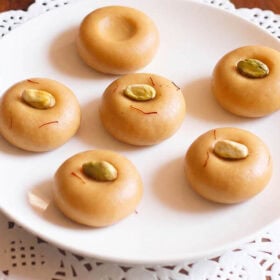
Mawa Peda (Khoya Peda)
Mawa Peda, also called Khoya Peda, is a soft Indian milk sweet made with mawa, whole milk, sugar and ghee. The mawa and milk mixture is flavored with saffron and cardamom, then cooked until thick. This slow cooking gives the pedas a gentle caramelized flavor and soft, moist texture. Shape them into small round pedas and serve during festivals, offer as prasad or enjoy as a sweet.
Servings: 12 Mawa Peda
Calories: 146kcal
Ingredients
- 1½ tablespoons ghee (clarified butter)
- 250 grams mawa (evaporated milk solids)
- 1 cup/240 ml whole milk
- ½ cup/100 grams sugar or add as required
- ¼ teaspoon cardamom powder
- 1 pinch saffron strands – optional
- 14 pistachios – to garnish, optional
- 1 pinch saffron strands – to garnish, optional
Instructions
Preparing The Mawa Mixture
- Crumble or grate the mawa finely so that there are no large lumps. Lightly grease a plate or tray with ½ tablespoon ghee and set aside.
- Heat the remaining 1 tablespoon ghee in a heavy-bottomed pan or kadai over low heat.
- Add the mawa and cook for 2 to 3 minutes, stirring continuously, until it softens and begins to melt.
- Pour in the milk and stir well until the softened mawa combines evenly with it. Break up any remaining lumps with the spatula.
- Add the sugar and mix well. The mixture will become thinner as the sugar dissolves.
- Add the saffron strands and stir to combine.
Cooking The Mixture
- Simmer the mixture over low heat for about 20 minutes, stirring at regular intervals. The milk will gradually reduce and the mixture will begin to thicken.
- Add the cardamom powder and mix well.
- Continue cooking over low heat for another 10 to 15 minutes. Stir continuously as the mixture thickens so that it does not stick to the bottom of the pan.
- The mixture is ready when it becomes thick, begins to leave the sides of the pan and the spatula leaves a clear trail through it. The exact cooking time may vary depending on the moisture in the mawa, the size of the pan and the intensity of the heat.
- Immediately transfer the mixture to the greased plate or tray. It will continue to thicken as it cools.
Making Mawa Peda
- Let the mixture cool until it is warm and comfortable to handle.
- Lightly grease your palms with ghee. Take a small portion of the mixture and roll it into a smooth ball. Press the center gently with your thumb or fingertip to make a shallow indentation.
- Alternatively, shape the mixture into small balls and flatten them slightly to make the traditional peda shape.
- Garnish the pedas with sliced pistachios or saffron strands. Let them cool completely before serving or storing.
Serving & Storage
- Serve Mawa Peda at room temperature as a festive sweet or dessert. You can also offer the pedas as prasad during puja and festivals.
- Refrigerate the pedas in an airtight container and use them within 4 to 5 days.
Notes
- Mawa: Use fresh, unsweetened mawa for the best taste. You can use homemade khoya if it is not available locally.
- Sweetened milk: Do not use sweetened condensed milk as a direct replacement for mawa. It will change the liquid and sugar proportions and require a different recipe.
- Low heat: Cook the peda mixture over low or medium-low heat throughout so that the milk solids do not stick, scorch or brown too deeply.
- Pan: Use a broad, heavy-bottomed kadai or pan. A broad pan allows the milk to reduce more evenly.
- Stirring: Stir at regular intervals while the mixture is simmering. Stir continuously once it begins to thicken.
- Consistency: The mixture is ready when it becomes thick, begins leaving the sides of the pan and the spatula leaves a clear trail through it.
- Cooling: Do not worry if the mixture is slightly soft when transferred to the tray. It will thicken and become easier to shape as it cools.
- Avoid overcooking: Overcooking can make the pedas dry, dense or chewy. Remove the mixture from the heat once it reaches the correct consistency.
- Scaling: The recipe can be doubled or tripled. Use a sufficiently large, broad pan and allow additional cooking time for the mixture to thicken.
Nutrition
Calories: 146kcal | Carbohydrates: 14g | Protein: 5g | Fat: 8g | Saturated Fat: 5g | Polyunsaturated Fat: 0.4g | Monounsaturated Fat: 2g | Trans Fat: 0.02g | Cholesterol: 11mg | Sodium: 64mg | Potassium: 43mg | Fiber: 0.1g | Sugar: 9g | Vitamin A: 131IU | Vitamin B1 (Thiamine): 0.02mg | Vitamin B2 (Riboflavin): 0.03mg | Vitamin B3 (Niacin): 0.04mg | Vitamin B6: 0.03mg | Vitamin B12: 0.1µg | Vitamin C: 0.3mg | Vitamin D: 0.2µg | Vitamin E: 0.03mg | Vitamin K: 0.2µg | Calcium: 169mg | Vitamin B9 (Folate): 1µg | Iron: 0.1mg | Magnesium: 4mg | Phosphorus: 26mg | Zinc: 0.1mg
