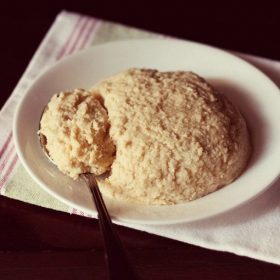
Khoya Recipe | Mawa Recipe
Khoya or Mawa is made by slowly simmering milk until most of the moisture evaporates and thick milk solids remain. This traditional method uses a kadai and continuous cooking to achieve the right texture. Homemade khoya has a fresh taste and works well in a variety of Indian sweets. Also known as khoa, it forms the base for many festive desserts.
Servings: 250 grams
Calories: 3kcal
Instructions
- Pour the milk in a large thick bottomed pan and place the pan on the stove top.
- Bring milk to gentle boil first on a low to medium heat.
- Then lower the heat and simmer the milk. Stir at intervals whilst the milk is simmering.
- The milk will froth many times, while its being simmered. So when you see this happening, with a spatula stir the milk.
- Scrape the milk solids from the sides and add to the milk.
- The milk will continue to reduce and thicken as its being simmered on a low flame.
- A stage will reach when the reduced milk will resemble rabdi (an indian sweet).
- Continue to simmer and stir.
- Towards the end when the milk has reduced much, you will see bubbles bursting in the reduced milk. At this point continuously stir. If you don't then the reduced milk will get browned or burnt. The bubbles are due to moisture in the milk.
- When you see no bubbles in the reduced milk, its time to switch off the flame. It took me 2 hours and 8 minutes overall on a low flame.
- With a spatula, scrape the milk solids from the sides and add these to the bowl. Cover the bowl and let the khoya cool at room temperature. Then you can refrigerate it.
- Add this homemade khoya or mawa as needed while making various indian sweets or Indian curries.
- When cooled, store khoya in an air-tight container. Refrigerate for 2 to 3 days or freeze for 6 to 8 days.
Notes
- Use a thick bottomed and heavy kadai (wok) or sauté pan.
- Ensure to stir the milk often as it simmers and slow cooks.
- Patience is a key when making homemade khoya from scratch with the traditional technique. You also need to be attentive so that the milk does not burn or get browned.
- Remember to use whole milk which is within its shelf period.
- Pair the task of making khoya with your other kitchen chores that need you to be in the kitchen.
Nutrition
Calories: 3kcal | Carbohydrates: 0.2g | Protein: 0.2g | Fat: 0.2g | Saturated Fat: 0.1g | Polyunsaturated Fat: 0.01g | Monounsaturated Fat: 0.04g | Cholesterol: 1mg | Sodium: 2mg | Potassium: 8mg | Sugar: 0.2g | Vitamin A: 8IU | Vitamin B1 (Thiamine): 0.003mg | Vitamin B2 (Riboflavin): 0.01mg | Vitamin B3 (Niacin): 0.01mg | Vitamin B6: 0.003mg | Vitamin B12: 0.03µg | Vitamin D: 0.1µg | Vitamin E: 0.003mg | Vitamin K: 0.02µg | Calcium: 6mg | Magnesium: 1mg | Phosphorus: 5mg | Zinc: 0.02mg
