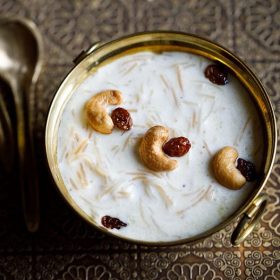
Semiya Payasam Recipe (Vermicelli Payasam)
Semiya Payasam is a rich and creamy South Indian sweet made with roasted vermicelli, milk, sugar and cardamom. Ghee-fried cashews and raisins add flavor and texture. This easy vermicelli payasam comes together in about 20 minutes. Serve it hot, warm or chilled for festivals, special occasions or after a meal.
Servings: 4
Calories: 473kcal
Ingredients
- 2 tablespoons ghee (clarified butter)
- 12 to 15 cashews
- 2 tablespoon raisins
- 1 cup semiya (vermicelli)
- 3½ cups whole milk
- 4 tablespoons sugar or add as required
- ½ teaspoon cardamom powder or 5 to 6 green cardamoms, crushed in mortar-pestle
Instructions
Frying Cashews & Raisins
- In a heavy kadai, add the ghee. Let it melt.
- When the ghee melts, add cashews. On a low heat fry the cashews until they become golden.
- Remove the golden fried cashews with a slotted spoon and then the raisins.
- Fry the raisins on a low heat. The raisins will soon start to swell up. Stir often while frying.
- Once the raisins swell, then remove them with a slotted spoon.
- Set the raisins aside with the fried cashews.
Roasting Semiya
- In the same kadai add the broken semiya.
- Mix well. Keep the flame to a low and begin to roast the semiya stirring often.
- Roast until the semiya becomes golden. Stir often while roasting semiya for even browning.
Making Semiya Payasam
- When the semiya has turned golden, add milk. Milk can be chilled, warm, hot or at room temperature. For a thin payasam, add 4 cups milk. Do note that on cooling the payasam thickens. So add milk accordingly.
- Mix very well.
- Keep the heat to a low or medium-low and simmer until the semiya softens and are cooked well.Do stir at intervals so that the milk or semiya does not stick or get burnt at the bottom of the pan or kadai.
- Simmer until the vermicelli strands are softened nicely.
- Then add sugar. You can add less or more sugar according to your desired sweetness.
- Sprinkle the cardamom powder.
- Mix very well and simmer on a low to medium-low heat for 2 to 3 minutes more. The sugar should dissolve.
- Turn off the heat and then add the fried cashews and raisins. You can even keep a few of the fried raisins and cashews as a garnish.
- Serve Semiya Payasam hot or warm.
Serving Suggestions
- Semiya payasam can be served hot, warm or chilled. When it comes to a room temperature, then you can refrigerate and serve later if you prefer that.
- On cooling and refrigerating payasam will thicken. So keep it to a slight flowing consistency when you want to serve it cold, so that it does not thicken too much. If at all the payasam has thickened too much, then simply add a bit of milk to thin the consistency.
Storage
- If there any leftovers, then refrigerate for 3 to 4 days in a covered container. I would not recommend freezing as the taste and texture changes.
- After refrigeration, you can reheat the payasam on low heat if you want to eat it hot or warm. Add some milk or water if the consistency has thickened too much.
Notes
- Jaggery: Add jaggery after the payasam cools slightly (after 4 to 5 minutes) to avoid curdling. If using coconut sugar or palm jaggery, follow the same method.
- Vegan Option: Swap dairy milk for almond or coconut milk. Fry the cashews and raisins in coconut oil, and cook the vermicelli in enough water. Strain the cooked semiya if there is extra water. Add the milk and raw sugar, heat gently—don’t boil.
- Adding Sugar: Make sure to add sugar after the vermicelli strands have softened well, when cooking in a pan on the stovetop.
- Consistency: Adjust milk for a thicker or thinner payasam. Reheat with extra milk if it thickens too much. For a lighter version, replace 1 cup of milk with water in the recipe.
- Scaling: Easily scale up for large gatherings or festivals.
- Serving Tip: Add a pinch of edible camphor if offering to deities.
Nutrition
Calories: 473kcal | Carbohydrates: 77g | Protein: 10g | Fat: 14g | Saturated Fat: 7g | Polyunsaturated Fat: 1g | Monounsaturated Fat: 1g | Cholesterol: 34mg | Sodium: 196mg | Potassium: 385mg | Fiber: 1g | Sugar: 27g | Vitamin A: 349IU | Vitamin B1 (Thiamine): 1mg | Vitamin B2 (Riboflavin): 1mg | Vitamin B3 (Niacin): 1mg | Vitamin B6: 1mg | Vitamin B12: 1µg | Vitamin C: 1mg | Vitamin D: 3µg | Vitamin E: 1mg | Vitamin K: 2µg | Calcium: 255mg | Vitamin B9 (Folate): 13µg | Iron: 1mg | Magnesium: 44mg | Phosphorus: 301mg | Zinc: 1mg
