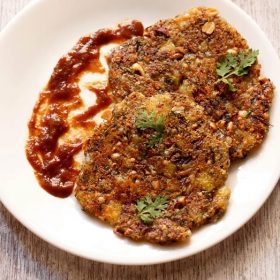
Sabudana Thalipeeth Recipe (Fasting Snack)
Sabudana Thalipeeth are crispy and soft pancakes made with tapioca pearls (sago), mashed potatoes, ground peanuts, herbs and spices. They are also called as Upvasache Thalipeeth in Marathi language and can also be referred to as Sabudana Roti.
Servings: 7 Sabudana Thalipeeth
Calories: 153kcal
Ingredients
- ⅔ cup sabudana (tapioca pearls)
- 2 medium or large potatoes - boiled, peeled and mashed
- ½ teaspoon cumin powder
- 4 tablespoon peanuts - roasted and coarsely ground
- ½ inch ginger - finely chopped or grated
- ¼ cup coriander leaves - chopped
- 1 teaspoon lemon juice
- 1 teaspoon sugar or add as required
- rock salt - edible and food grade (sendha namak), add as required
- peanut oil or ghee as required for pan-frying
Instructions
Soaking sabudana
- Pick and rinse the sabudana well till you get transparent water when rinsing.
- Soak them overnight in enough water in a bowl.
- The next day, drain all the water very well.
- Make sure there is no water in them.
Making sago mixture
- Add the mashed potatoes and all the ingredients to the soaked sabudana. Mix well.
- Heat a non stick frying pan or a well seasoned cast uron skillet or tawa.
- Spread 1 or 2 teaspoon of peanut oil or ghee on the pan.
- Apply some oil on your palms.
- Take some portion from the mixture and flatten it with your palms.
- You can also flatten on a ziplock bag.
Cooking sabudana thalipeeth
- Place the flattened round (thalipeeth) on the frying pan. Keep the heat to medium-low or medium.
- Fry till both sides are golden brown and crisp. Repeat.
- If you have a large pan, you can cook 2 to 3 thalipeeth at the same time.
Serving suggestions
- On fasting days, serve sabudana thalipeeth with any chutney or raita or homemade tomato ketchup made without onions and garlic.
- You can also have it with curd (yogurt) that has been sweetened with some sugar or jaggery.
- For non-fasting days, you can serve with a chutney or raita or tomato ketchup made with onions or garlic.
Notes
- Make sure to soak the sabudana pearls according to their variety and quality, that is, either overnight or for a couple of hours. Soaking of sago pearls helps them to soften and they get mashed easily, when pressed between the fingers.
- It is important to soak the sabudana very well and they should be completely softened and do not have any hardness in the center. Under-soaked sabudana will burst while cooking and also make the thalipeeth hard in texture.
- To avoid a pasty or sticky texture in the dish, drain sabudana very well.
- You have to cook the potatoes until soft, and not overcook as then the thalipeeth mixture will become sticky. Also, drain them well and mash while potatoes are still hot or warm. Then, add lukewarm mashed potatoes to sabudana.
- You can use a stovetop pressure cooker, steamer, pan or Instant Pot to cook the potatoes. Add water, as required depending on the mode of cooking or equipments you use.
- For a spicy taste, add finely chopped green chilies. In place of coriander, you can even add 2 tablespoons mint leaves for a minty flavor.
- For fasting, use peanut oil or ghee to roast or pan-fry the thalipeeth. For non-fasting days, you can use any neutral flavored oil.
- It is best to use a non-stick pan or well-seasoned cast iron skillet to cook these rotis. Using these, you can avoid sticking of the thalipeeth on the pan.
- Make a non-satvik variant of the same recipe by adding some onions, garlic or garlic chives in it. Use regular white salt, instead of rock salt. It makes for a tasty tea/coffee time snack.
- You can easily halve, double or triple this recipe for making smaller or larger batches.
Nutrition
Calories: 153kcal | Carbohydrates: 14g | Protein: 2g | Fat: 10g | Saturated Fat: 2g | Sodium: 187mg | Potassium: 64mg | Fiber: 2g | Sugar: 1g | Vitamin A: 40IU | Vitamin B1 (Thiamine): 1mg | Vitamin B2 (Riboflavin): 1mg | Vitamin B3 (Niacin): 1mg | Vitamin B6: 1mg | Vitamin C: 1mg | Vitamin E: 2mg | Vitamin K: 2µg | Calcium: 7mg | Vitamin B9 (Folate): 13µg | Iron: 1mg | Magnesium: 16mg | Phosphorus: 31mg | Zinc: 1mg
