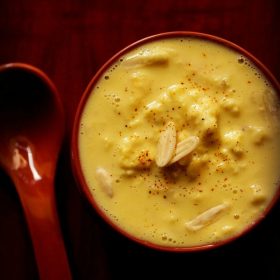
Rabdi Recipe | Traditional Rabri
Rabdi or Rabri is a traditional North Indian sweet made by slow simmering milk until it reduces, thickens and forms layers of clotted cream (malai). It is lightly flavored with cardamom and saffron, then topped with nuts and dried fruits for added texture and flavor. Serve it chilled as a dessert or pair it with Indian sweets like malpua or jalebi.
Servings: 3
Calories: 136kcal
Ingredients
- 1¼ litres whole milk
- 2.5 to 3 tablespoons sugar or add as required
- ½ teaspoon cardamom powder or 5 to 6 green cardamoms, crushed in mortar-pestle
- 12 to 15 saffron strands (kesar), crushed
- 1 teaspoon rose water or kewra water (pandanus water)
- 2 tablespoons almonds (badam), blanched and sliced
- 2 tablespoons pistachios (pista), blanched and sliced
Instructions
Preparing Nuts
- Soak almonds and pistachios in hot water for 20 to 30 minutes. Drain the water. Then remove the peels from the nuts.
- Slice or sliver or chop them and set aside.
Cooking Milk To Half Of Its Volume
- Take whole milk in a thick bottomed kadai or pan and begun to heat the milk on a low to medium heat, till the milk starts to froth or form a layer of clotted cream (malai) on top. Stir a couple of time when the milk is getting heated.
- So when you will see the cream floating on top, then with a spatula, gently move the cream layer.
- Bring it towards the side of the pan and stick it to the pan. Keep the heat to a low and continue to simmer.
- Keep on simmering the milk like this and collecting the cream layer on the sides.
- This process of collecting the cream layer has to be done many times. continuous simmering of the milk will bring the cream on top and you have to bring and stick it to the sides of the pan.
- In between also stir the milk gently on occasions, so that the milk does not get burnt from the bottom. If you do too much of stirring and if quickly, then you won't get the layers of cream in the rabri.
- So after you have moved the layer of cream (malai) to the side of the pan, then stir the milk a few times. Then wait until another layer of cream forms on the surface of the milk.
- You can also just thicken and scrape the milk solids from the sides but in this case you won't get the layers of clotted cream or malai in the rabdi.
Making Rabdi
- Once the milk reduces to half, then add sugar. You can add sugar as per your taste preferences.
- Then add crushed saffron strands and cardamom powder. Stir gently.
- Continue collecting the cream and bringing it to the sides of the pan. Also do stir the milk gently after you bring the cream towards the sides of the pan. If you don't stir the milk then there is a possibility of the milk getting browned or burnt from the bottom.
- After adding saffron, the color will change gradually to a beautiful yellow color as the milk keeps on reducing.
- When the milk gets reduced to ⅓ or ¼ of its original quantity, then switch off the heat. It took me about 1 hour 15 minutes on a low heat initially and medium heat towards the latter stage. I cooked it until ⅓ of its original volume.
- The cream layer will be collected on the sides with a spatula. Scrape off the entire cream layer as well as dried milk solids and add into the thickened milk.
- Stir gently. Then add the sliced almonds, pistachios and 1 teaspoon rose water or kewra water. Stir gently again. Reserve a few of the blanched and slivered nuts for garnish
Serving & Storage Suggestions
- Garnish with some of the blanched almond and pistachio slivers. Serve rabdi hot or warm.
- If you are not serving hot or warm, let it cool at room temperature first. Transfer the cooled rabdi in an air-tight steel container and refrigerate it for a few hours.
- Keep in mind that it will thicken more as it cools at room temperature and even in the refrigerator. So keep the consistency slightly thin if you want to refrigerate it and serve cold or chilled.
- Whether you serve hot or warm or cold, if you prefer, garnish with some of the blanched, slivered nuts and sprinkle a bit of crushed saffron from top.
- Rabdi keeps well in the refrigerator for about 3 to 4 days. Store any leftover in an air-tight container or bowl in the fridge.
Video
Notes
- Pan: Use a heavy thick-bottomed kadai or a wok with a large surface area. A wider pan helps the milk reduce faster and prevents it from burning while cooking.
- Milk: For the best texture and flavor, use whole milk or full-fat milk. Avoid low-fat or skimmed milk.
- Cooking: Simmer the milk on low heat and stir at intervals so it does not scorch at the bottom. When a layer of malai forms on top, do not stir as it can break the layer. Gently move the malai to the sides of the pan with a spatula, then continue simmering until the next layer forms.
- Nuts & flavorings: You can add almonds, cashews, pistachios or pine nuts, either chopped or slivered. Flavor the rabdi with cardamom powder, saffron, rose water, kewra water or vanilla extract.
- Blanching nuts: Blanching the nuts is optional. You can simply slice or sliver them and add directly to the rabdi.
- Scaling: This recipe serves 3, but can be easily doubled or scaled further. Keep in mind that a larger quantity of milk will take more time to reduce and thicken.
Nutrition
Calories: 136kcal | Carbohydrates: 15g | Protein: 4g | Fat: 8g | Saturated Fat: 1g | Polyunsaturated Fat: 2g | Monounsaturated Fat: 4g | Cholesterol: 1mg | Sodium: 1mg | Potassium: 157mg | Fiber: 2g | Sugar: 11g | Vitamin A: 27IU | Vitamin B1 (Thiamine): 1mg | Vitamin B2 (Riboflavin): 1mg | Vitamin B3 (Niacin): 1mg | Vitamin B6: 1mg | Vitamin B12: 1µg | Vitamin C: 1mg | Vitamin D: 1µg | Vitamin E: 2mg | Vitamin K: 1µg | Calcium: 31mg | Vitamin B9 (Folate): 9µg | Iron: 1mg | Magnesium: 30mg | Phosphorus: 80mg | Zinc: 1mg
