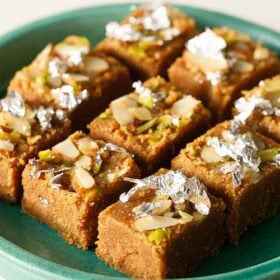
Mohanthal Recipe
Mohanthal, also spelled Mohan Thal, is a famous Gujarati sweet made with besan (gram flour) roasted in ghee and set with saffron sugar syrup. The besan is first rubbed with warm ghee and milk, rested and sieved, which gives the sweet its signature grainy texture. This version is made without khoya and flavored with cardamom and nutmeg. Cut into squares, it is a classic sweet for Diwali, Janmashtami, pujas and other festive occasions.
Servings: 20 pieces
Calories: 175kcal
Ingredients
For The Dhrabo
- 2 cups/220 grams gram flour (besan), semi-fine or coarse
- ¼ cup/55 grams ghee – melted and warm
- ¼ cup/60 ml whole milk – warm
For Roasting
- ½ cup/110 grams ghee
For Finishing
- ¼ cup/60 ml whole milk – at room temperature
- 1 teaspoon cardamom powder
- ⅛ teaspoon nutmeg – freshly grated or nutmeg powder
For The Sugar Syrup
- 1 cup + 2 tablespoons/225 grams sugar – organic or white sugar, use 1 cup for a less sweet taste
- ½ cup/120 ml water
- 20 saffron strands – lightly crushed, optional
For Garnish
- 2 tablespoons almonds – sliced or chopped
- 2 tablespoons pistachios – sliced or chopped
- 1 sheet edible silver leaf – chandi vark, optional
Instructions
Preparation
- Grease a 6-inch square tray or a deep thali with a little ghee. You can also line it with parchment paper and brush some ghee on the paper.
- Keep a coarse sieve (chalni), a thick-bottomed heavy kadai or frying pan, a second pan for the syrup and a spatula ready. Measure the finishing milk, cardamom powder and nutmeg and keep them within reach, as the later steps move quickly.
Make The Dhrabo
- Take the besan in a large bowl and set aside.
- In a small pan, take the ghee and milk for the dhrabo. Heat on low only until the ghee melts. The mixture should be warm, not hot.
- Pour the warm ghee and milk mixture over the besan and mix with a spoon.
- Rub the mixture between your fingertips and palms using both hands, several times, until it looks grainy and sand-like. A fistful should hold its shape when pressed.
- Cover the bowl and rest the mixture for 20 to 30 minutes so that the besan absorbs the moisture evenly.
Sieve The Dhrabo
- Sift the mixture through a coarse sieve to get even, crumbly granules like rava (semolina).
- Pulse any large lumps left in the sieve in a mixer-grinder until they look like breadcrumbs, then sift again. No big lumps should remain, as they can stay raw in the middle.
- If you don't have a coarse sieve, grind the whole mixture in short bursts in a mixer-grinder until it looks like breadcrumbs or rava.
Roast The Dhrabo
- Heat the ghee for roasting in a thick-bottomed heavy kadai or frying pan on low or medium-low heat. Once it melts, add the sieved dhrabo (granular besan mixture) and mix well.
- Roast on low to medium-low heat for 20 to 25 minutes, stirring non-stop. Do not stop stirring at any point, or the besan will stick to the bottom and burn. The mixture is thick at first, then loosens and turns liquid, and later splutters, froths and bubbles.
- Roast until the besan is an even deep golden color, smells nutty, the ghee starts separating and the mixture looks slightly thin and molten. Do not let it turn too brown or dark. If it looks dry or sticks to the kadai, add a little more ghee.
Add Milk & Spices
- Turn off the heat and add the room temperature milk. It will sizzle and froth a lot, so step back as you pour. Mix very well.
- Turn the heat back on to low and stir continuously for 1 to 2 minutes until all the milk is absorbed and the mixture becomes thick and grainy.
- Turn off the heat. Add the cardamom powder and nutmeg, mix well and keep the kadai aside. Stir a few times so that the besan at the bottom does not burn or darken from the heat of the kadai.
Make The Sugar Syrup
- Right away, combine the sugar, water and crushed saffron in another pan. Stir on medium heat until the sugar dissolves.
- Stop stirring once the syrup boils. Boil for 8 to 10 minutes until it reaches one-string consistency. Start testing after 5 minutes. A slightly cooled drop pulled between your thumb and forefinger should form one thread.
Combine & Make Mohanthal
- Pour the hot syrup into the warm besan mixture and mix quickly and well. It will look loose and glossy at first and thicken in 1 to 2 minutes into a thick, pourable, cake batter-like mixture.
- If it is still runny after 4 to 5 minutes, stir on low heat for 1 to 2 minutes until it thickens and starts leaving the sides. If it seizes and turns crumbly, add a little hot milk and mix on low heat until it comes together.
- As soon as the mixture is evenly mixed and still pourable, transfer it to the prepared tray and tap the tray on the counter a few times. Level with a spatula only if the mixture is too thick to settle on its own.
- Sprinkle the chopped pistachios and almonds on top and press them in lightly with the spatula.
- Let the mohanthal cool and set at room temperature for 3 to 4 hours or overnight. If using, top with the edible silver leaf. Cut into neat squares.
- Serve as a sweet or a sweet snack.
- Store in an airtight container at room temperature for up to a week, or refrigerate for 2 to 3 weeks.
Notes
- Use a thick-bottomed heavy kadai or frying pan. In a thin pan, the besan sticks and burns easily.
- Stir non-stop while roasting the gram flour. If you stop stirring, the mixture can stick to the bottom and burn.
- Semi-fine besan gives a nice granular texture. Coarse besan (mota or ladoo besan) makes it more granular. Fine besan forms lumps easily, so rub and sieve well.
- Do not skip the dhrabo, resting and sieving. These steps give mohanthal its grainy texture.
- Roast the besan on low to medium-low heat. Go by color and aroma, not only the time.
- Cook the syrup only to one-string consistency. Undercooked syrup keeps the mohanthal soft and runny, while overcooked syrup makes it hard and crumbly.
- Work quickly once the syrup is added and pour the mixture after mixing very well.
- The recipe can be scaled proportionately.
- Note that the approximate nutrition info is for 1 mohanthal piece made from this recipe.
Nutrition
Calories: 175kcal | Carbohydrates: 19g | Protein: 3g | Fat: 10g | Saturated Fat: 5g | Polyunsaturated Fat: 1g | Monounsaturated Fat: 3g | Cholesterol: 21mg | Sodium: 12mg | Potassium: 143mg | Fiber: 2g | Sugar: 13g | Vitamin A: 24IU | Vitamin B1 (Thiamine): 0.1mg | Vitamin B2 (Riboflavin): 0.04mg | Vitamin B3 (Niacin): 0.3mg | Vitamin B6: 0.1mg | Vitamin B12: 0.03µg | Vitamin C: 1mg | Vitamin D: 0.1µg | Vitamin E: 0.4mg | Vitamin K: 1µg | Calcium: 19mg | Vitamin B9 (Folate): 50µg | Iron: 1mg | Magnesium: 26mg | Phosphorus: 56mg | Zinc: 0.4mg
