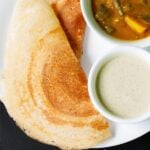
Dosa Recipe (Traditional Dosa Batter)
This Dosa Recipe shows how to make traditional South Indian dosa using a fermented batter made from rice and urad dal. The dosa batter is spread thin and cooked until crisp, resulting in light, golden dosas that pair well with chutney and sambar.
Servings: 16 Dosa
Calories: 74kcal
Ingredients
- ½ cup or 100 grams idli rice or parboiled rice or regular rice
- ½ cup or 100 grams regular rice
- ¼ cup or 50 grams urad dal (husked whole or split black gram)
- ⅛ teaspoon or 2 pinches fenugreek seeds (methi seeds or methi dana)
- 2 tablespoons thick poha (flattened rice)
- 1.5 cups water – for soaking both rice and lentils
- ¾ cup water – for grinding, do add water as required
- ½ teaspoon rock salt – edible and food grade or non-iodized salt or sea salt crystals or Himalayan pink salt
- oil as required, for cooking dosa
Instructions
Soaking Urad Dal & Rice
- In a bowl take the idli rice or parboiled rice along with the regular white rice.Instead of adding regular rice, you can also make the dosa with a total of 1 cup idli rice as I have shown in the video. The video has the recipe ingredients doubled in proportion.
- To the same bowl, add urad dal and fenugreek seeds.
- Rinse the rice, lentils and methi seeds together a couple of times and keep aside.
- In a separate bowl, take the flattened rice.
- Rinse it once or twice in water and then add rinsed flattened rice to the bowl containing the rinsed rice+lentils+methi seeds.
- Pour 1.5 cups water. Mix. Cover with a lid and soak everything for 5 to 6 hours.
Making Dosa Batter
- Drain all the water and add the soaked ingredients in a wet grinder jar.
- Add ⅔ to ¾ cup water and grind till you get a fine grainy consistency of rice in the batter. A smooth consistency of batter is also fine.
- If the mixer gets heated up, then stop and wait for some minutes. When the mixer cools down, grind again. Depending on the jar capacity, you can grind everything once or in two batches. I ground in two batches and added overall ¾ cup water.
- Now take the batter in a large bowl or pan.
- Add ½ tsp rock salt. Mix very well. Cover and allow to ferment for 8 to 9 hours or more. Time of fermentation will vary depending on the temperature conditions.
- A proper fermentation will double or triple up the volume of the batter and you will see tiny air pockets in the batter with a light sour aroma.
- Now lightly stir the batter, before you begin to make dosa.
Making Dosa
- Heat a cast iron pan. When the pan becomes hot, spread ¼ to ½ teaspoon oil all over the pan. Do keep the heat on low to low-medium heat, so that you are easily able to spread the batter. If the pan base is very thick, then keep the flame to medium.
- Do not spread oil if you are using a nonstick pan, as you won't be able to spread the batter.
- Now take a ladle full of the batter. Pour the dosa batter and gently spread the batter starting from the center and moving outwards.
- Cover it with a lid and cook the dosa on a low to medium heat. Do regulate the flame as per the pan size and thickness.
- When you see the batter on the top has cooked well and the bottom has become crisp and golden, then sprinkle ¼ to ½ teaspoon oil on the edges and center.
- With the spoon spread the oil on the dosa.
- Cook till the base is nicely golden and crisp. The base will leave the pan and the sides will also get separated when it gets cooked.
- Fold and serve sada dosa hot. Make all dosai this way.
Serving Dosa
- Serve these crispy plain dosa hot with sambar or potato masala or coconut chutney. Dosa tastes best when served immediately.
Storing Batter
- Refrigerate leftover batter in an airtight container for 2 to 3 days.
- Stir gently before use and adjust consistency with a little water if needed. The batter may turn slightly sour over time.
Video
Notes
- Scaling: You can halve, double, or triple this sada dosa recipe. When doubling or tripling, soak urad dal and fenugreek seeds separately and grind them separately from the rice. Grind the soaked rice in two to three batches and mix both batters together before fermentation.
- Rice: You can make this dosa using only idli rice instead of a mix of idli rice and regular rice. In the video, the ingredient quantities are doubled.
- Temperature: Fermentation depends largely on temperature. In warm climates, the batter ferments easily overnight. In cooler climates, it may take longer and needs a warm place.
- Urad dal: Use fresh, good-quality urad dal within its expiry date for proper fermentation and texture.
- Salt: Salt slightly slows fermentation. You can add salt before fermentation if you use the batter quickly. For longer fermentation or storage, add salt just before making dosa.
- Cooler climate fermentation: Keep the batter in a warm spot, near a heater, or inside a switched-off preheated oven (80 to 90°C for 10 minutes). You can also keep the batter in an oven with the light on, ensuring the oven does not heat up. A pinch of sugar can help kick-start fermentation in winter. Allow 14 to 24 hours if needed.
- Signs of proper fermentation: The batter may not always double in volume. Look for tiny bubbles and a mild sour aroma.
- Emergency fixes: If the batter does not ferment, you can add ¼ to ½ teaspoon instant yeast dissolved in water about 30 to 45 minutes before making dosa. Use the batter the same day. Baking soda can also be used in cold seasons, but it affects flavor slightly.
- Wet grinder method: If using a wet grinder, double the recipe. For ½ cup urad dal, add about 1.5 cups water. For 2 cups rice, add about 2.5 cups water. Add water gradually while grinding urad dal and fenugreek seeds until fluffy. Grind rice next in the same grinder, then transfer the batter to a bowl, add salt if using, and ferment.
Nutrition
Calories: 74kcal | Carbohydrates: 12g | Protein: 2g | Fat: 2g | Saturated Fat: 1g | Sodium: 75mg | Potassium: 13mg | Fiber: 1g | Sugar: 1g | Vitamin B1 (Thiamine): 1mg | Vitamin B2 (Riboflavin): 1mg | Vitamin B3 (Niacin): 1mg | Vitamin B6: 1mg | Vitamin C: 1mg | Vitamin E: 1mg | Vitamin K: 1µg | Calcium: 6mg | Vitamin B9 (Folate): 1µg | Iron: 1mg | Magnesium: 3mg | Phosphorus: 15mg | Zinc: 1mg
