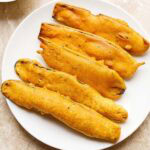
Beguni Recipe (Bengali Style)
Beguni is a traditional Bengali fritter made with thin slices of eggplant dipped in a lightly spiced gram flour batter and deep fried. The coating turns crisp while the eggplant stays soft. Kalonji adds sharp notes and mustard oil gives authentic flavor. It is best served hot as a tea time snack.
Servings: 3
Calories: 350kcal
Ingredients
- 2 long purple or (105 to 110 grams) eggplants
- 1 cup or (120 grams) gram flour (besan)
- 2 tablespoons rice flour
- ½ teaspoon nigella seeds (kalonji/kalo jeera)
- ¼ teaspoon turmeric powder
- ½ teaspoon Kashmiri chilli powder or regular red chilli powder
- ½ teaspoon cumin powder
- ½ teaspoon salt or add according to taste – for batter
- ½ cup + 2 tablespoons water or add as needed
- mustard oil as required for deep frying
Instructions
Preparation
- Prepare a smooth, medium flowing batter using gram flour, rice flour, ground spices, salt and water. Set aside.
- The batter should be medium and flowing, coating the back of a spoon without dripping off immediately.
- Slice the eggplant lengthwise into thin slices, about 2 to 3 mm thick.
- Try to keep the slices even, but slight unevenness is normal with long, slender eggplants and does not affect the final texture.
- Keep the slices aside. Do not salt and do not soak them in water.
- Tip – checking bitterness: Most fresh eggplants are not bitter. Taste a small raw piece from the centre of one slice. If it tastes neutral or mildly sweet, use as is. Salt the slices only if they taste bitter. Rest for 10 to 15 minutes, then wipe completely dry before battering.
Making Beguni
- Heat oil in a kadai or wok until it becomes moderately hot.
- If using cold-pressed mustard oil, heat until it just starts smoking, then reduce the heat. Refined mustard oil only needs to be heated to medium.
- Dip each eggplant slice in batter and evenly coat it with the batter. Let the excess batter drip back naturally into the batter bowl.
- Gently place the batter coated eggplant slice in the medium hot oil. Batter-coat the remaining slices and place them in the hot oil, ensuring not to overcrowd the pan.
- You can fry 3 to 4 long slices depending on the size of the pan.
- When one side becomes crisp, turn over and fry the second side.
- Fry turning over as needed until the eggplant fritters are golden with crisp edges and soft centers.
- Remove fried beguni with a slotted spoon and place on kitchen paper towels. Deep fry the remaining eggplant slices in batches until golden and crispy.
- Serve beguni hot with choice of chutney or sauce. You can also pair with puffed rice (muri) or jhal muri. It also tastes nice as a side with khichdi or a simple meal of dal and rice.
Notes
- Use a heavy pan: A heavy-bottomed, wide pan heats evenly and prevents the batter from burning.
- Keep the batter consistency right: The batter should be medium and flowing. A thick batter makes the coating heavy and doughy.
- Choose the right eggplant: Use small to medium or long purple or green eggplants. Large eggplants or aubergines tend to absorb more oil and can turn greasy. They may also have more mature seeds, which can taste bitter.
- Check for bitterness: Most fresh eggplants are not bitter. Taste a small raw piece from the centre. Salt the slices only if they taste bitter, then wipe them dry before frying.
- Do not salt by default: Salting releases moisture and affects texture. Skip it unless the eggplants are bitter.
- Maintain frying temperature: Fry in medium-hot oil. Oil that is too hot browns the batter before the eggplant slices cook; oil that is too cool makes the fritters oily. Do not over brown.
Nutrition
Calories: 350kcal | Carbohydrates: 30g | Protein: 10g | Fat: 22g | Saturated Fat: 2g | Polyunsaturated Fat: 5g | Monounsaturated Fat: 12g | Sodium: 421mg | Potassium: 443mg | Fiber: 6g | Sugar: 6g | Vitamin A: 128IU | Vitamin B1 (Thiamine): 0.2mg | Vitamin B2 (Riboflavin): 0.1mg | Vitamin B3 (Niacin): 1mg | Vitamin B6: 0.3mg | Vitamin C: 1mg | Vitamin E: 1mg | Vitamin K: 5µg | Calcium: 27mg | Vitamin B9 (Folate): 183µg | Iron: 2mg | Magnesium: 75mg | Phosphorus: 144mg | Zinc: 1mg
