
Sabudana Vada Recipe (For Fasting)

Sabudana Vada is a popular Maharashtrian fasting snack made with soaked tapioca pearls (sabudana), mashed potatoes, roasted peanuts, herbs and spices. These patties are crisp from outside and soft, light from within. The recipe is naturally gluten-free and vegan, making it suitable for vrat or fasting days. With the right soaking and frying method, you get perfectly crispy sabudana vada every time.
About Sabudana Vada Recipe
Sabudana, also called sago or tapioca pearls, are small white balls made from the roots of the cassava plant (tapioca or yuca). They are commonly used during Hindu fasting periods.
The word sabudana is a Hindi term used in North, Central and Western India. In South India, it is known as javvarisi (Tamil), sabbakki (Kannada), chowari (Malayalam) and sagubiyyam (Telugu).
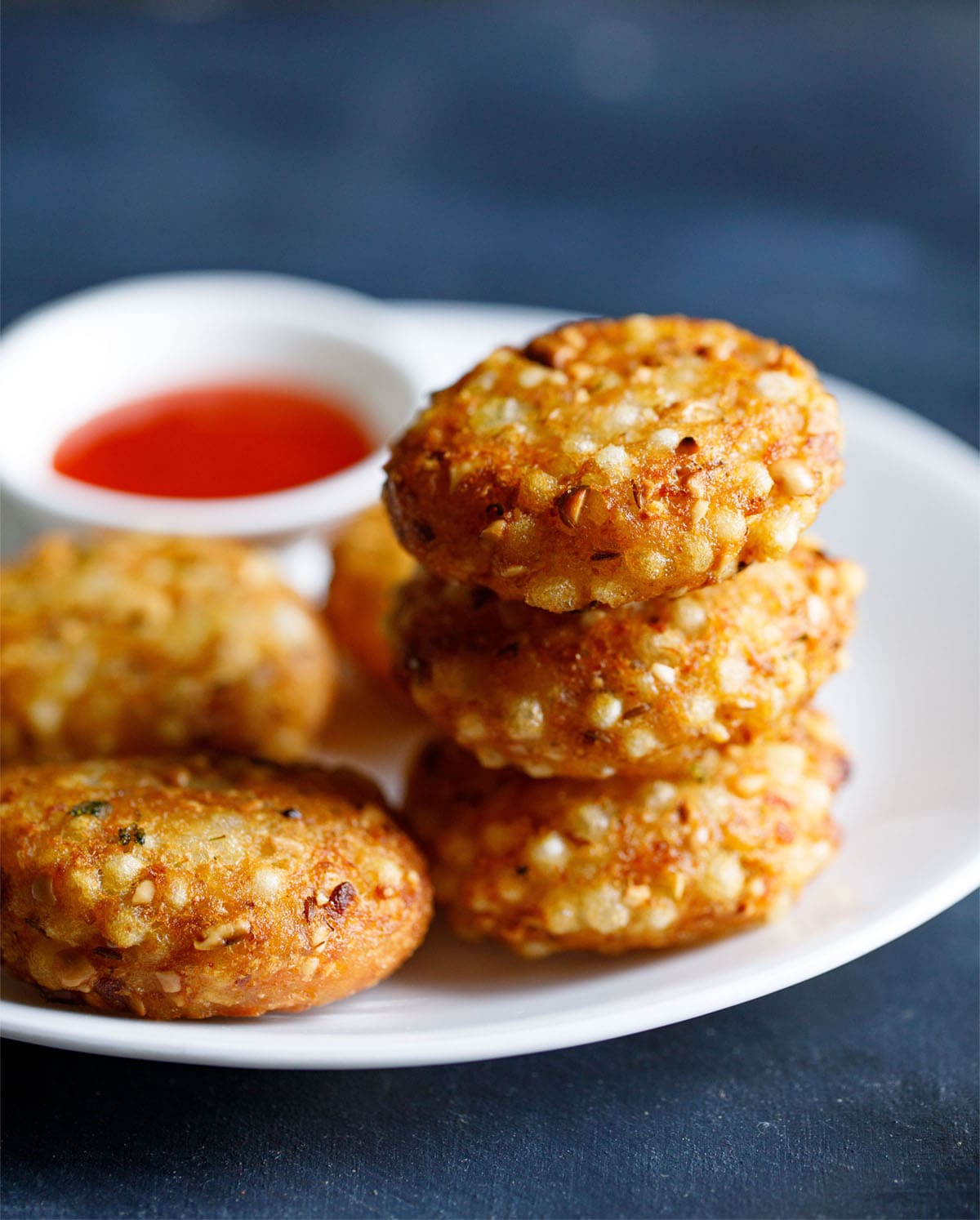
Table of Contents
Sabudana is mainly starch and high in carbohydrates, which helps keep you full for longer. It is a popular fasting ingredient during Ekadashi, Mahashivratri, and Navratri when ingredients like onions, garlic, wheat, lentils and pulses are avoided.
Some popular fasting dishes made with it include sabudana vada and Sabudana Khichdi.
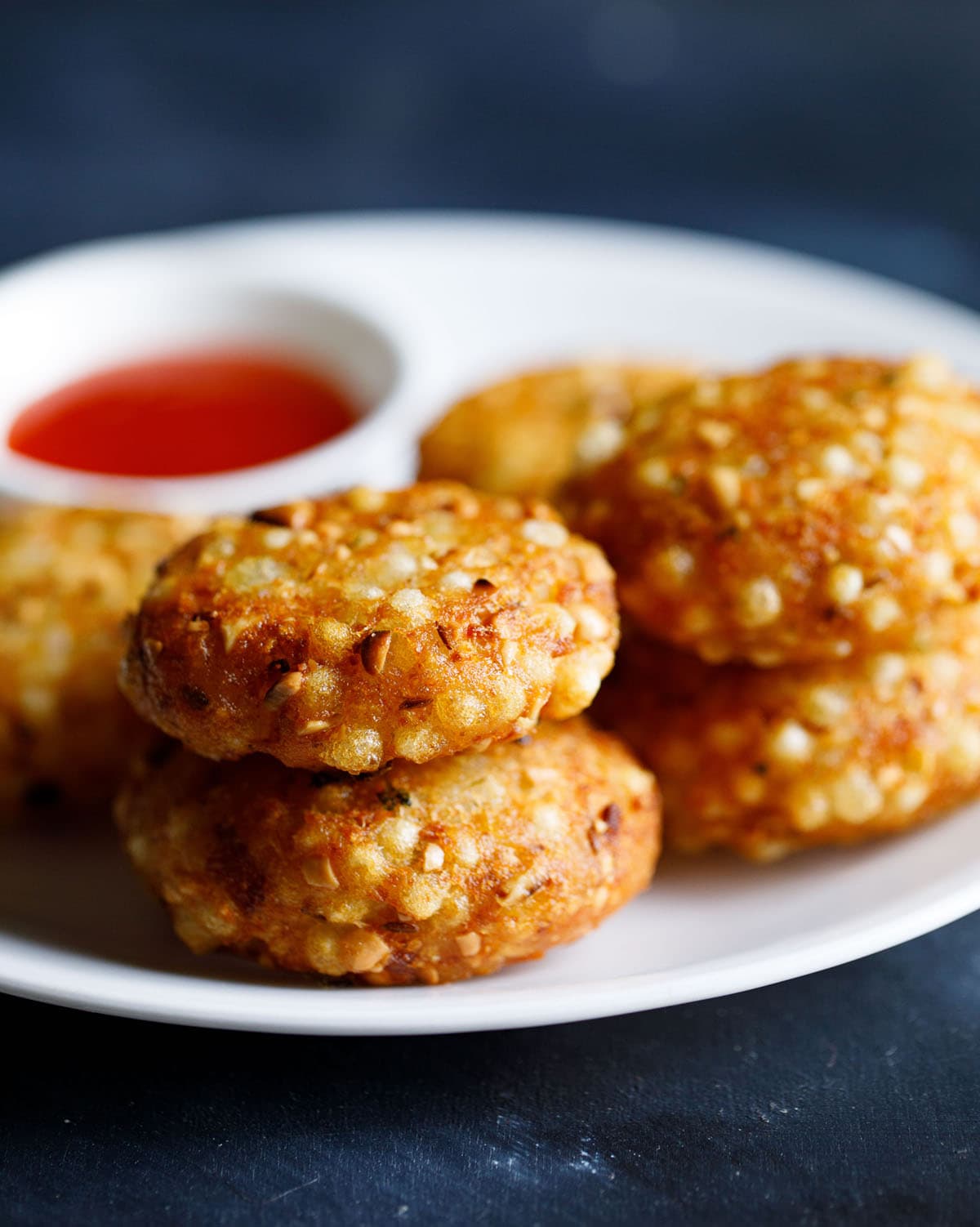
Sabudana Vada are deep-fried patties that are crisp from outside and soft inside. They are made with soaked tapioca pearls, potatoes, roasted peanuts, herbs, spices, lemon juice, a little sugar and salt.
The sabudana is soaked until softened, then mixed with mashed or grated potatoes, crushed peanuts and spices. The mixture is shaped into patties and deep-fried until golden. Potatoes help bind, while peanuts add crunch and flavor.
This is an authentic Maharashtrian satvik recipe of sabudana vada made without onions, garlic or heavy spices.
The balance of potatoes and sabudana helps the mixture bind well without adding any flour. Hence the sabudana vada turn out crisp and golden outside, soft inside, and do not break or turn soggy while frying.
Sabudana vada is served as a snack or brunch and are also popular at sweet shops and street stalls across Mumbai and Maharashtra.
You can also use sabudana to make Sabudana Kheer, Sabudana Thalipeeth, Sabudana Pakora, Sabudana Tikki and Sabudana Papad.
How To Make Sabudana Vada (Stepwise)
Follow these steps to prepare crispy and soft sabudana vada at home. We’ll begin with soaking the sabudana.
Soak Sabudana
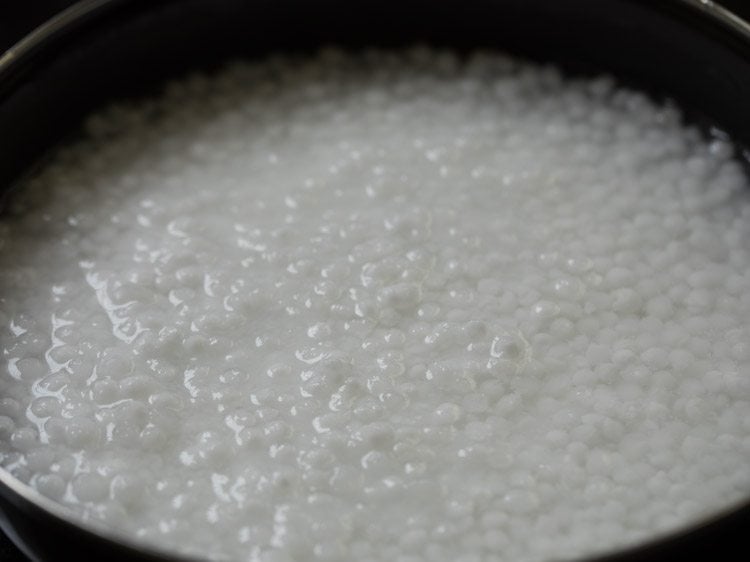
1. You need to plan ahead and soak the sago pearls. It is very important to soak the sago really well. Well soaked sabudana make for a soft, light and fluffy vada.
Important: Please refrain from using un-soaked or under-soaked sabudana to avoid scalding or burns as they will burst and shatter in oil when frying.
First, using a colander or mesh strainer rinse 1 cup sabudana lightly twice or thrice draining all the water. Then soak the rinsed pearls in 2 to 2.5 cups water for 5 hours at least or overnight.
I always soak them overnight and by morning they become nicely soft. Some varieties of sabudana can also be soaked for 2 to 3 hours. I get a really hard textured sabudana and soaking them for 2 to 3 hours does not help.
So depending on the quality of your sabudana, soak for 2 to 3 hours or more. To test that they have soaked and softened really well, follow the points mentioned in the second step below.
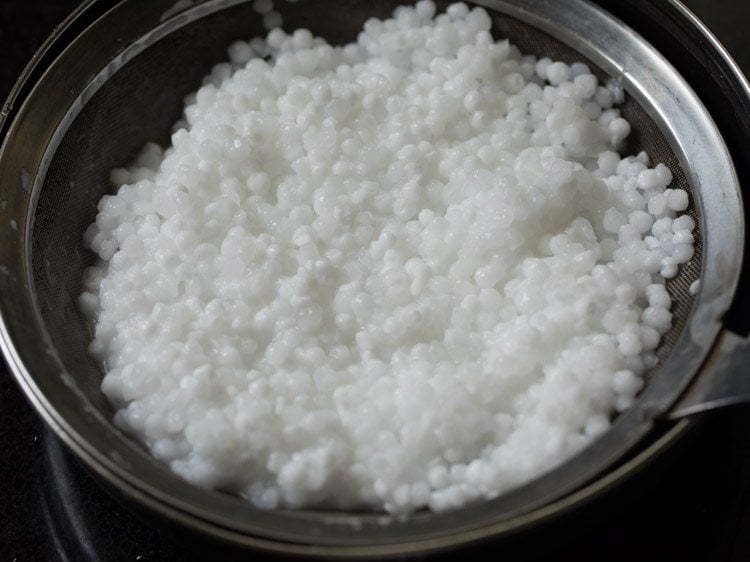
2. When properly soaked, the sabudana pearls will be tender without any hard center. When you press the pearls between your forefinger and thumb, they would get mashed easily with a floury texture on your fingers.
If you feel some hardness in the center, then soak for some more time. When they are softened well, drain all the water from the soaked sabudana.
Note: Remember not to use the sabudana pearls if they are not soaked well or have a hard center. These under-soaked sabudana will splatter or burst in the hot oil when frying.
Keep in mind that there should not be any water logged in the soaked pearls. Water will definitely make the patties moist and sticky.
Hence these waterlogged patties will soak up a good amount of oil while frying making them loaded with oil. Also a lot of water in the patties may cause them to shatter or fall apart in the oil during deep frying.
So drain the water really well. You can opt to gently and lightly press the soaked pearls in the strainer with a spoon or spatula. Or set aside the pearls in a strainer (keeping a bowl beneath) for some 20 to 30 minutes dripping of any extra water.
Use this time to prep your other ingredients. This is what I do. I let the soaked pearls sit in the strainer and begin to cook the potatoes and prep the other vada ingredients.
Handy Tip: If in case you find the soaked sabudana has too much of moisture even after straining well, add some flour to the patty mixture like – buckwheat flour, amaranth flour, water chestnut flour. These flours will help absorb the excess moisture from the sago pearls.
Cook & Crumble Potatoes
3. Scrub and rinse 4 medium-sized potatoes thoroughly in water first. Then place the potatoes in a 3 litre cooker. Add water which just about covers the potatoes.
Note that you can choose to cook potatoes in a pan or in an Instant Pot.
1. If cooking in a pan, take water and add peeled and chopped potatoes. The water should cover the potatoes. Add a 2 to 3 pinches of salt if preferred. Cover and simmer potatoes until fork tender. Later drain the water really well and set the cooked potatoes aside.
2. For Instant Pot cooking, place a trivet in the inner steel insert of your Instant Pot. Add 1.5 cups water. Place the rinsed potatoes on the trivet. Seal with the lid and position the valve to sealing. Press the manual/pressure cook button and set the time to 10 or 12 minutes with high pressure option.
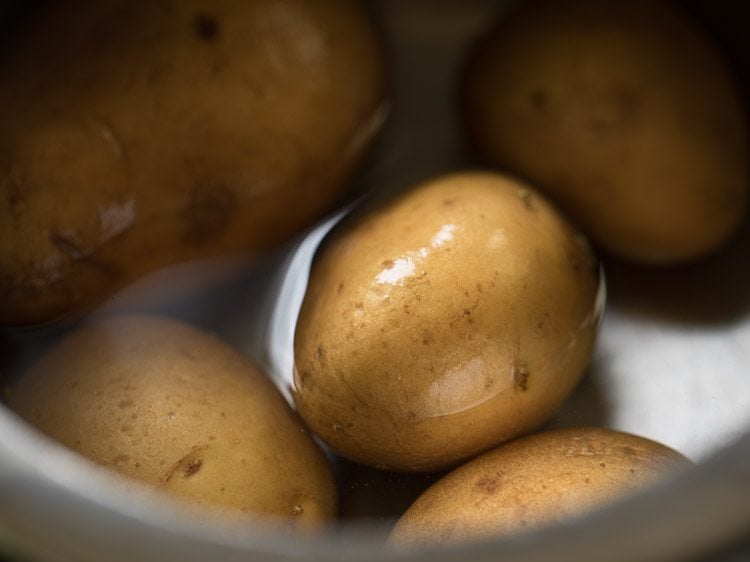
4. For the stove-top pressure cooker, boil potatoes for 10 to 12 minutes or 4 to 5 whistles on medium-heat.
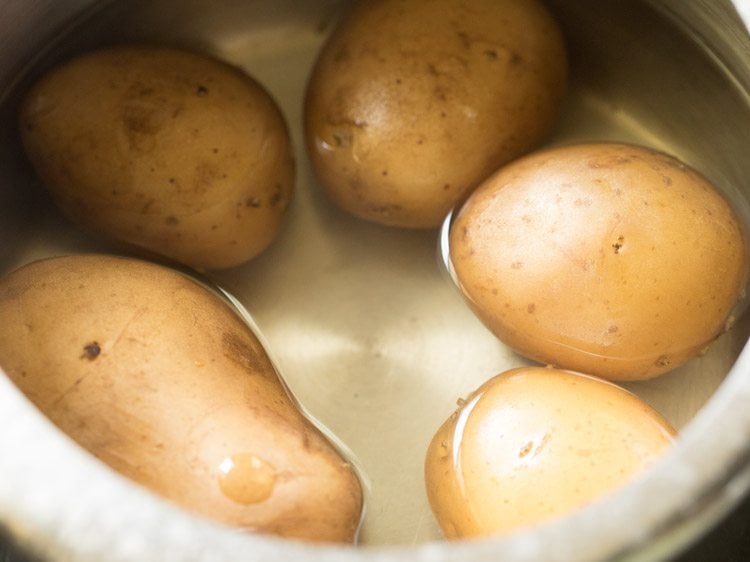
5. No matter how you have cooked the potatoes, you need to check if they are tender and softened.
1. For the stove-top pressure cooker, when the pressure settles down on its own in the cooker, then only open the lid and check the potatoes. Pass a knife or fork through the center of the potatoes and it should slide easily without any resistance.
2. For Instant pot, after you hear the beep when the pressure cooking is complete, wait for 5 minutes and then do a quick pressure release. Carefully, remove the potatoes with tongs and place them in a plate or tray. Check the potatoes to see if they are cooked tender with a fork or knife.
3. For pan, check the cooked potatoes with a fork or knife. Then using a strainer, drain all the water.
Whether you have cooked your potatoes on a stove-top or in the Instant Pot, you have to drain the water really well. Ensure that you do not have water logged in the cooked potatoes.
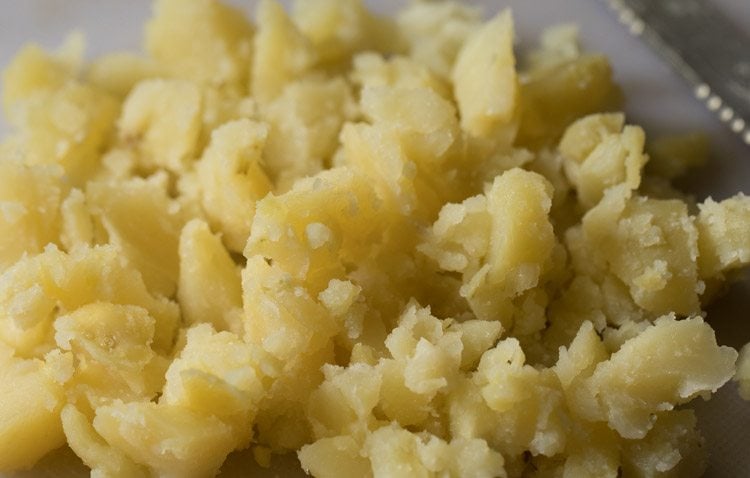
Let the potatoes become warm. Later peel and then chop them or crumble them. You can even mash them.
Remember to crumble or mash them really well. There must not be any potato chunks in the patty mixture.
Roast & Crush Peanuts
6. When the potatoes are cooking, you can roast the peanuts. Heat a pan or kadai and add ½ cup peanuts in it.
If you have pre-made roasted peanuts, then skip these steps on roasting peanuts.
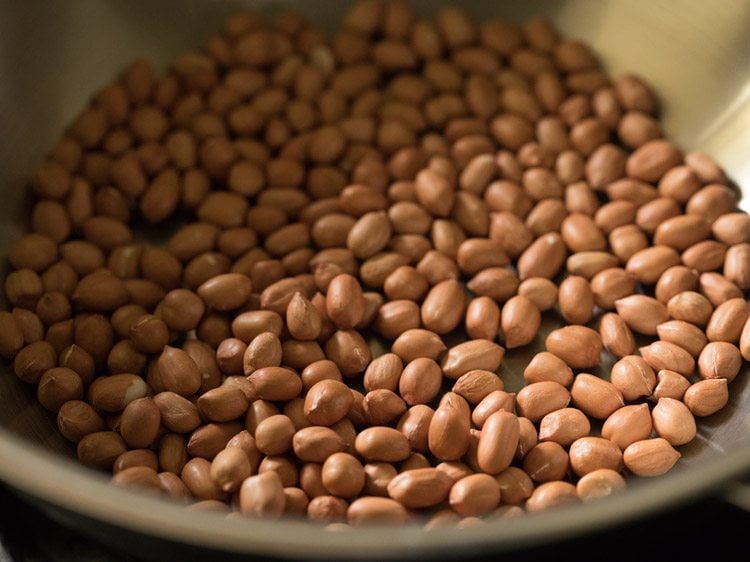
7. On a low to medium heat, stirring often roast the peanuts. Use a heavy pan, so that the peanuts do not get burnt.
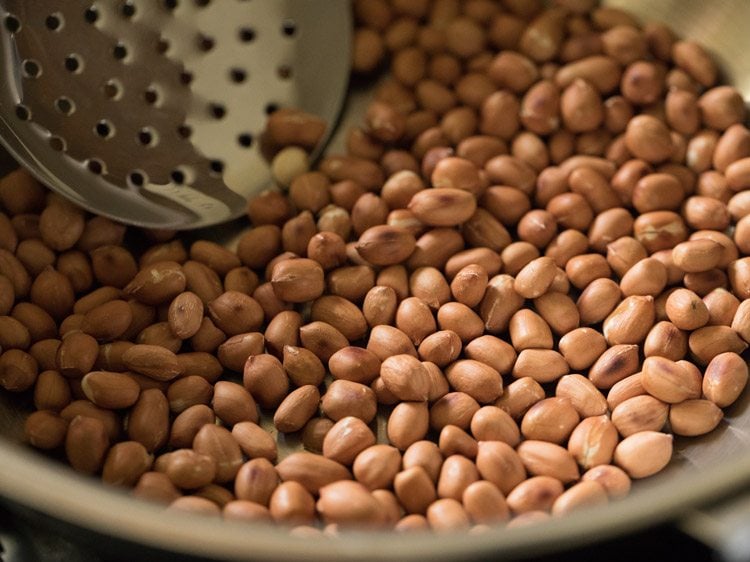
8. Roast the peanuts until you see a few black chars or spots on their husks. They should be crunchy and well roasted with no rawness or hardness in the center.
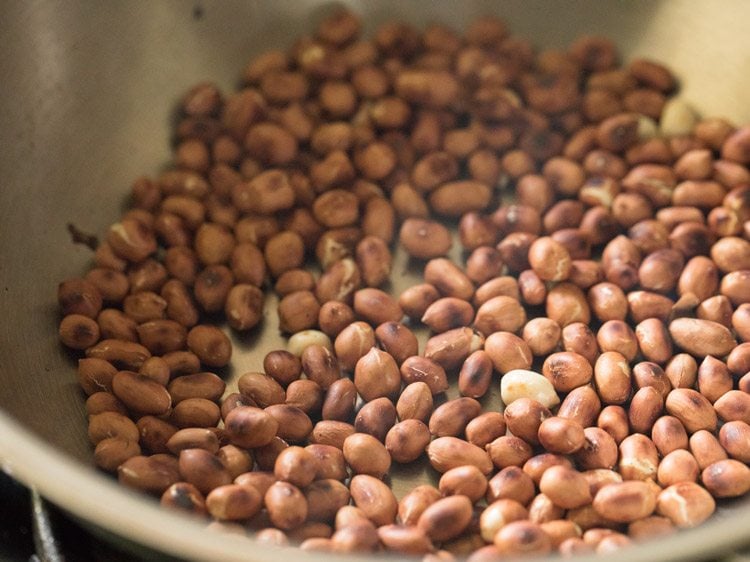
9. Transfer the peanuts to a plate and let them cool at room temperature. Once they are cooled, add them in a dry grinder or spice grinder. I have removed the husks. If you want you can keep them.
How to remove the peanut husks? Take the cooled peanuts in your palms and rub them with your palms over your kitchen sink, so that the thin husks fall in the sink and not fly all around in your kitchen.
You can also take them in a cotton kitchen towel. Bring the edges of the napkin in the center making a bundle and then rub the peanuts in the bundle with your palms.
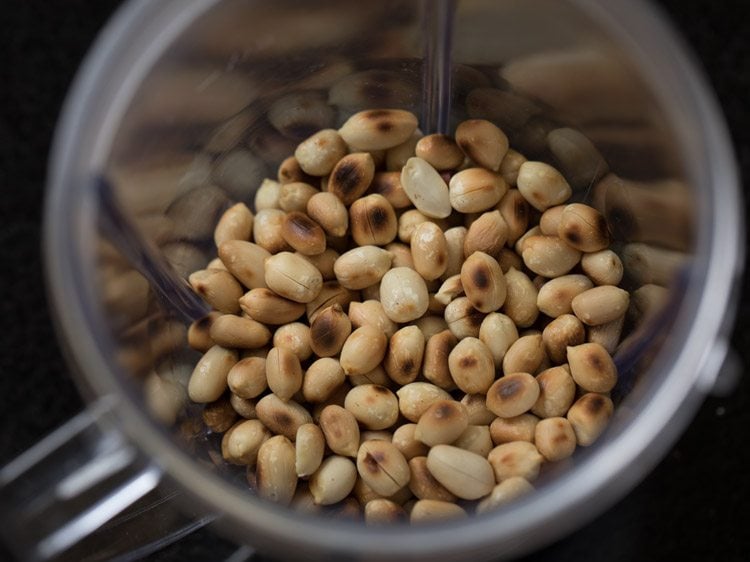
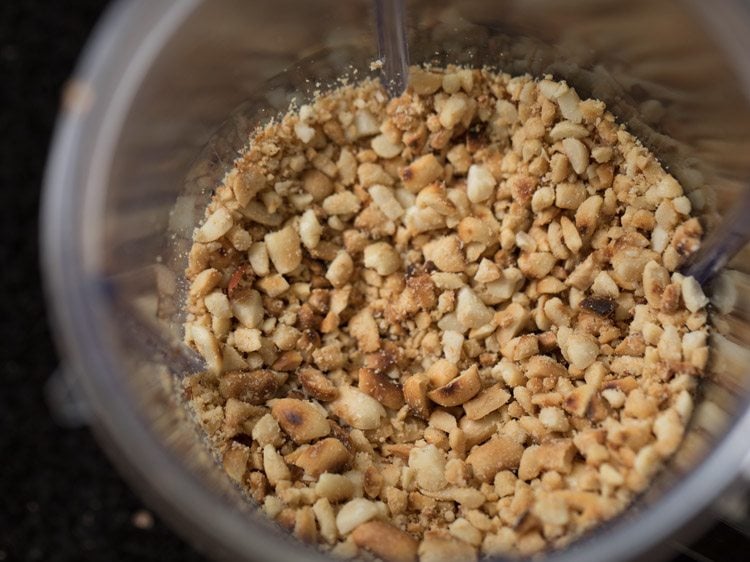
11. Grind to a semi-coarse powder. Keep the peanut powder aside. You can even make a fine powder if you like.
Make Sago Mixture
3. When the sabudana pearls are drained really well of any extra water, take the pearls in a mixing bowl.
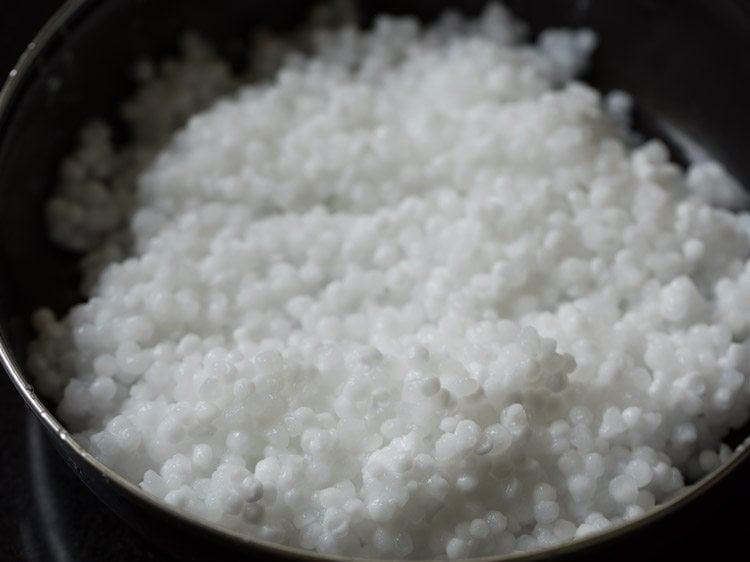
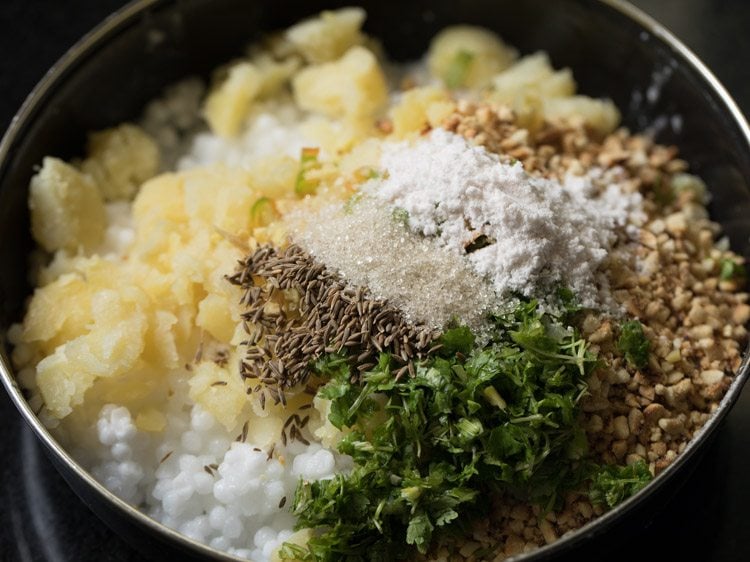
12. Add the mashed potatoes and coarsely roasted groundnuts to the sabudana in the mixing bowl.
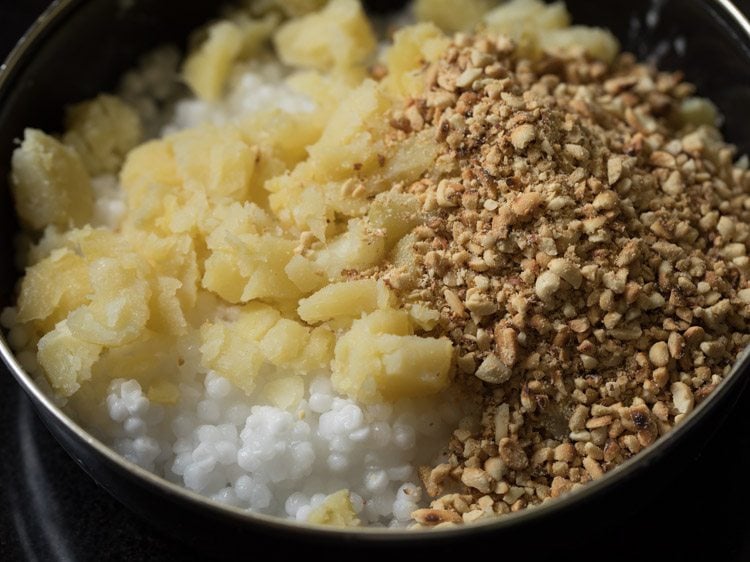
13. Next add 1 to 2 chopped green chilies (about ½ to 1 teaspoon), 1 teaspoon peeled & finely chopped ginger and 2 tablespoons chopped coriander leaves.
You can skip coriander leaves if you do not have them.
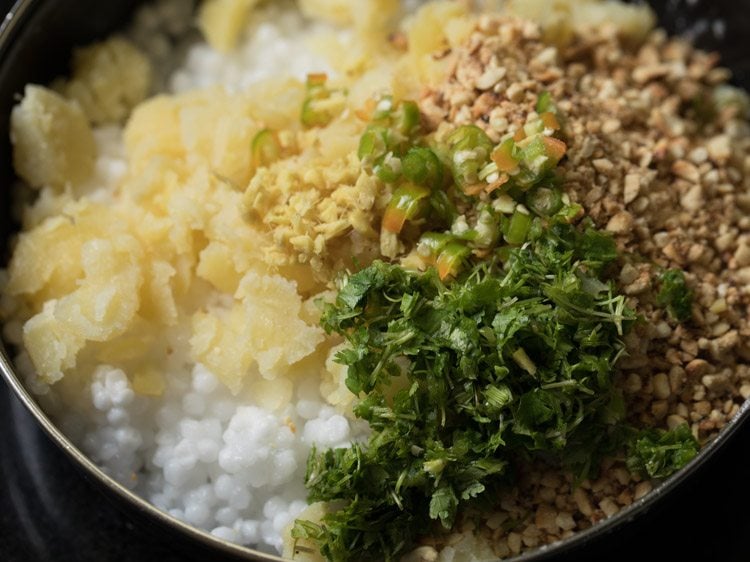
14. Squeeze 2 teaspoons lemon juice or add according to your taste.
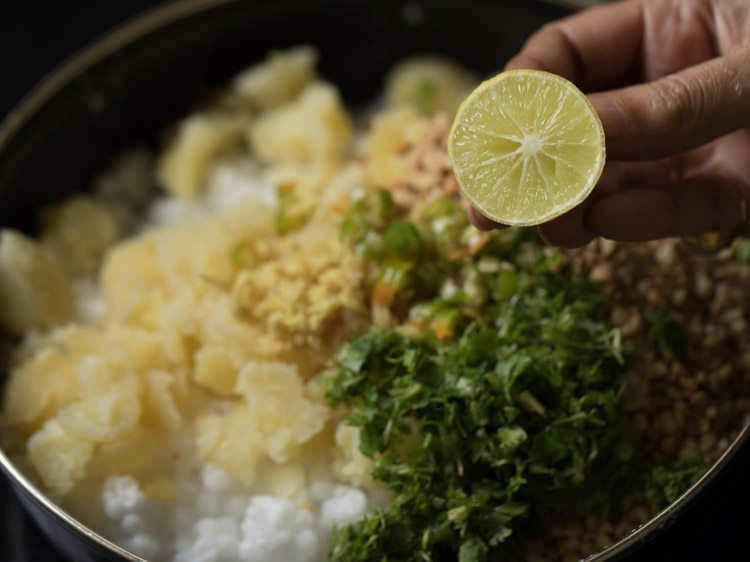
15. Now add 1 teaspoon cumin seeds, 1.5 teaspoons sugar and salt as per your taste. You can add less or more sugar as you like.
Mix and Shape into Patties
16. Combine and mix thoroughly with your hands or with a spoon. Check the taste and add more salt, sugar and lemon juice if needed.
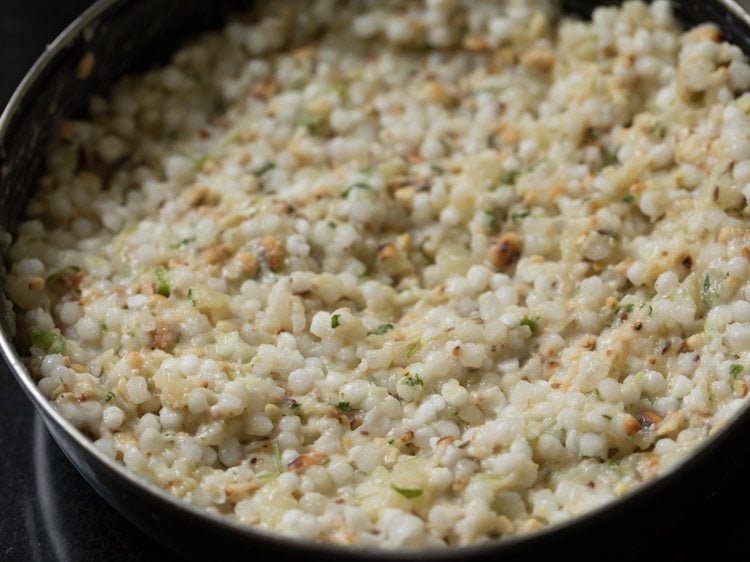
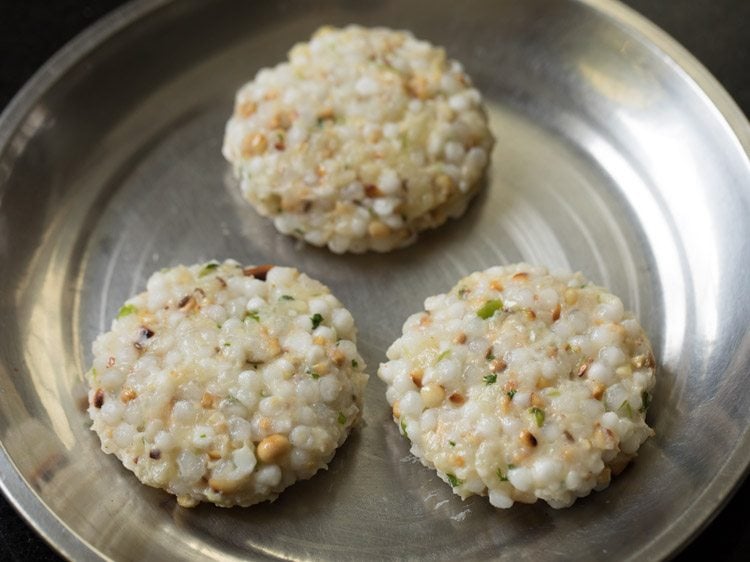
17. Now take some portion of the mixture in your hands and shape them into a flat round patty which is neither thin or thick. This way use up all of the sabudana dough mixture. Set the patties aside.
Tip: You can rub a bit of oil in your palms while forming the patties, so that the mixture does not stick to your palms.
Make Sabudana Vada
18. Heat oil for deep frying in a kadai (wok) or a pan. Keep the heat to medium. When you see the oil shimmering, add a small patty. It should come up steadily and gradually in the oil.
Tip 1: If the small patty breaks while frying, the mixture has excess moisture. Add more mashed potatoes (if you have it) or 2 to 3 tablespoons of buckwheat, water chestnut, or amaranth flour. For non-fasting days, use rice flour. Mix well, reshape, and then fry.
Tip 2: Make sure to use a well-seasoned pan for frying so that the vada does not stick to it.
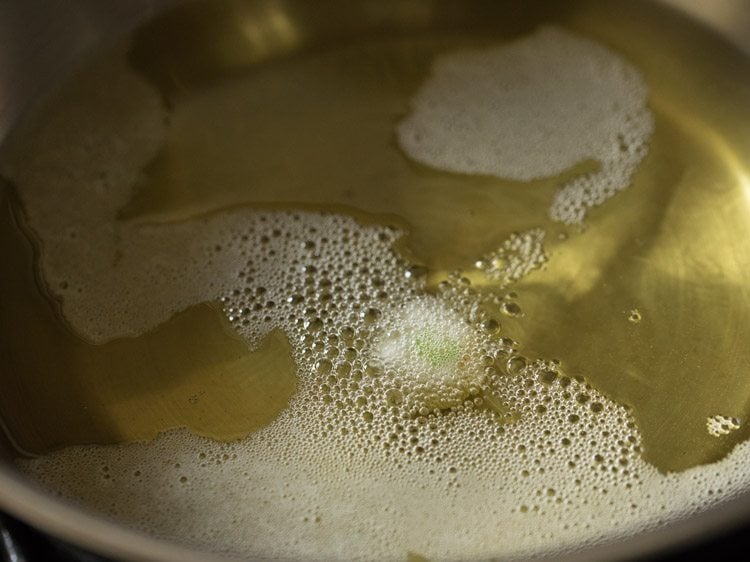
19. Gently place the patties in hot oil. Fry them at medium heat. Do not overcrowd the pan while frying.
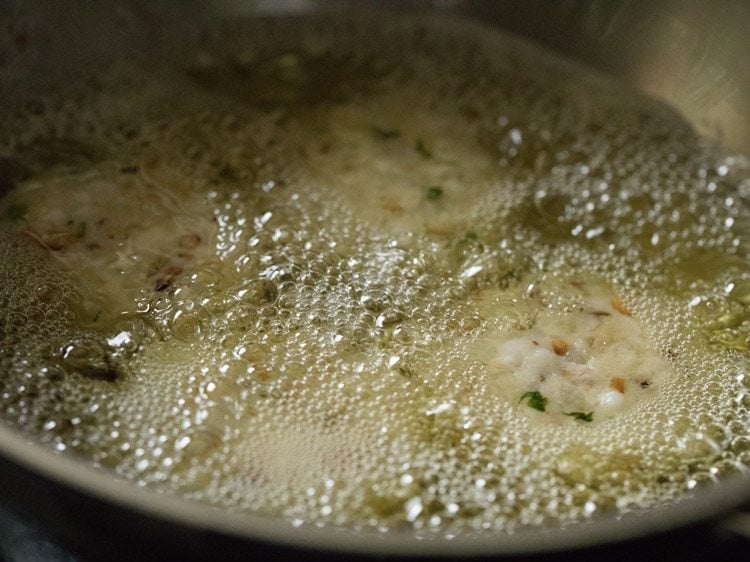
20. When one side is light golden, then only turn them over with a slotted spoon. Do not be in a hurry to turn them as the raw, under-cooked vada will fall apart in the oil.
When the sabudana vada looks crispy, light golden, then only gently turn them over.
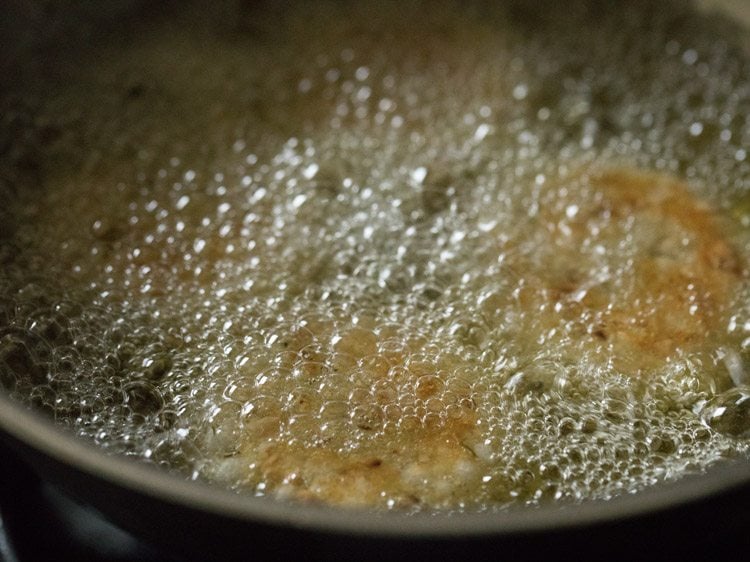
21. Turn over again when the second side is golden.
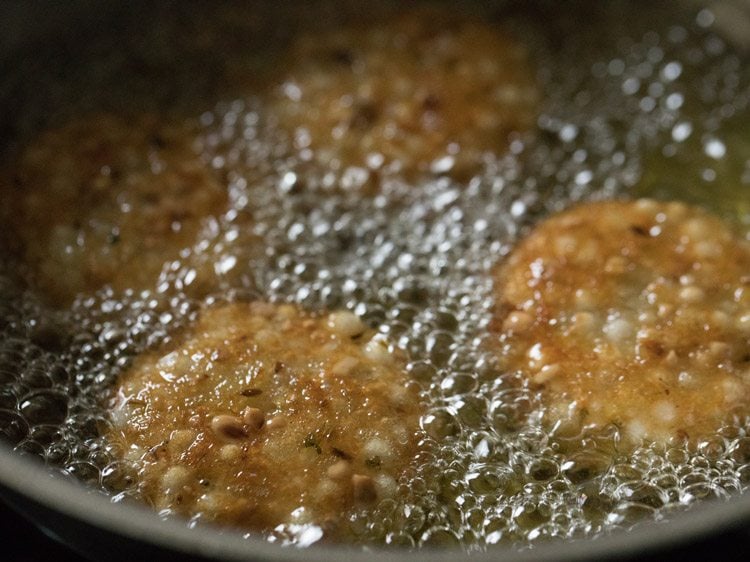
22. Continue to fry turning over a couple of times until the sabudana vada is evenly golden and crisp.
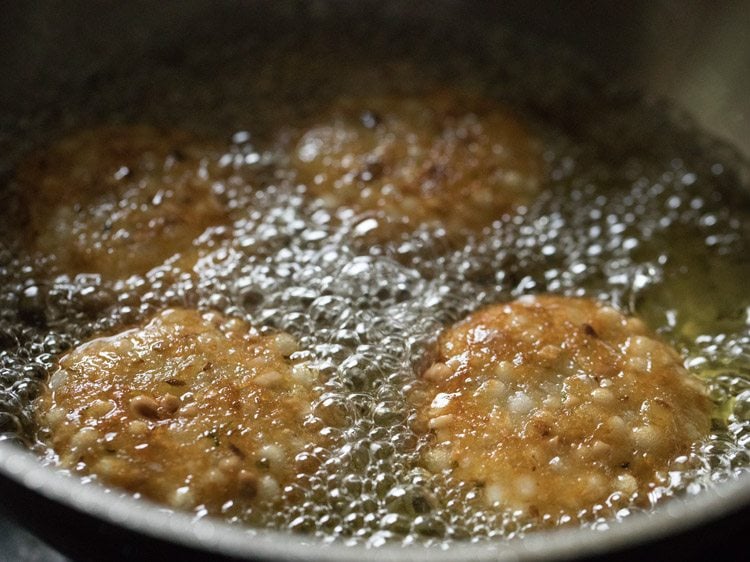
23. Remove the fried sabudana vada with a slotted spoon draining the extra oil in the pan.
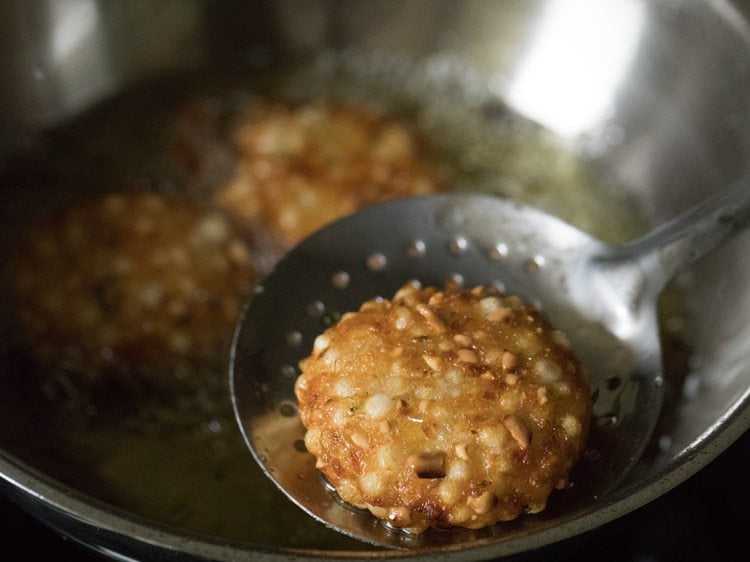
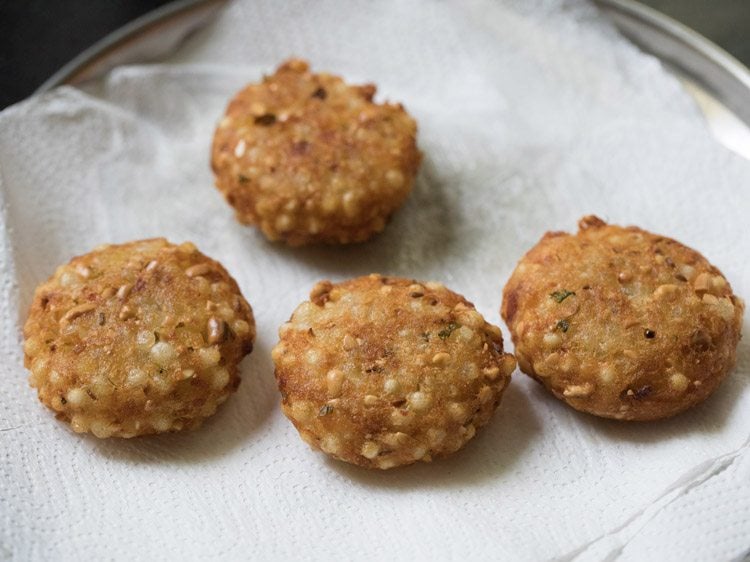
24. Place the fried sabudana vada on kitchen towels to absorb excess oil. Fry all the sago patties this way. Fry the remaining batches of the prepared vada in this manner.
Serving Suggestions
Sabudana Vada can be made for fasting days or as an evening snack. It tastes best with Coconut Chutney or sweetened Curd (Indian yogurt).
To make sweetened curd, simply mix sugar into fresh curd. You can also serve with Tamarind Chutney, Coriander Chutney or a homemade tomato ketchup.
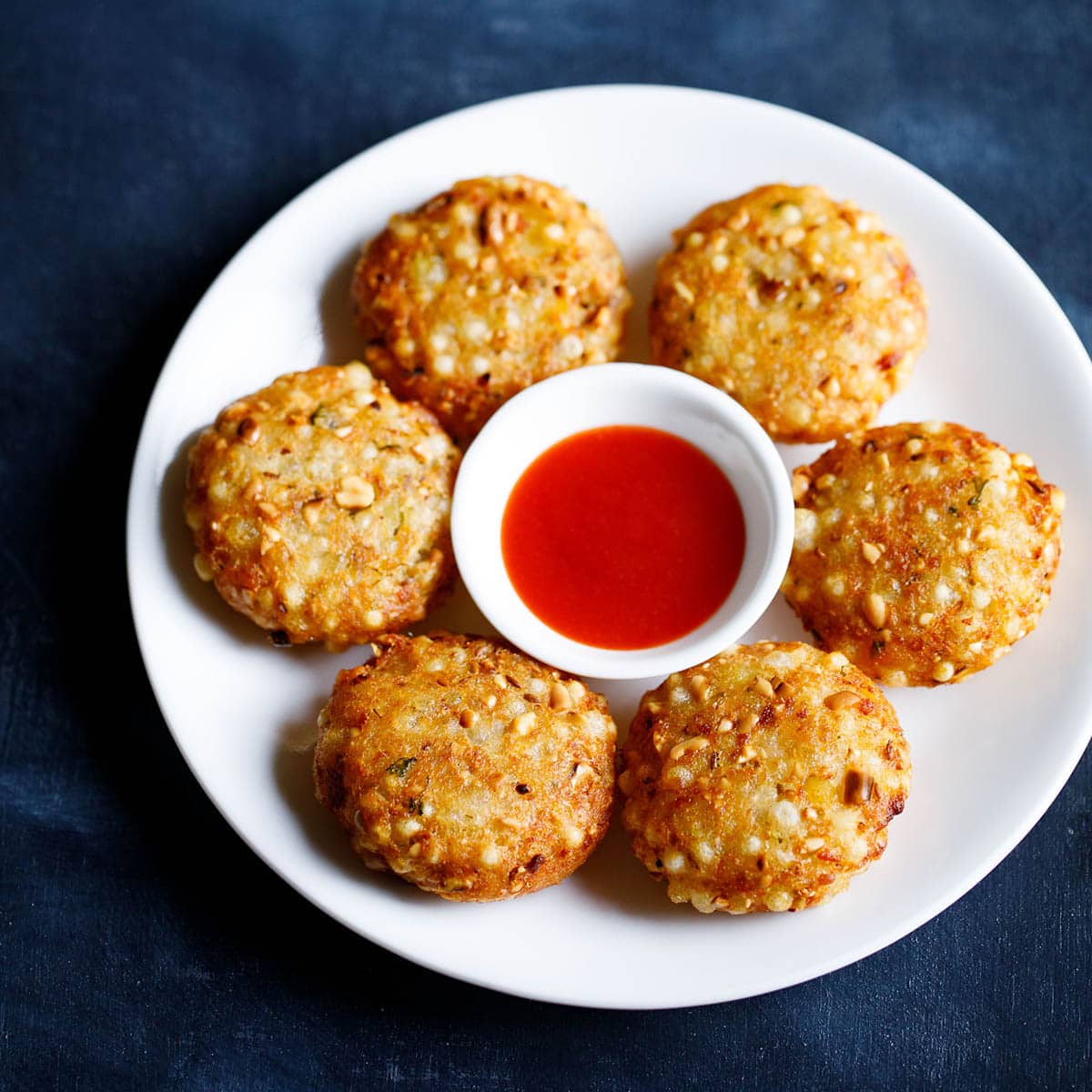
Serve sabudana vada hot or warm for best taste. In the photos, I served them with a sweet tamarind and red chilli chutney. I had made these as an evening snack.
They can also be served at room temperature, and a well-made sabudana vada remains soft even after cooling.
Make Ahead Options
To make ahead, boil, peel, mash and store the potatoes in your refrigerator a day prior. Roast peanuts and powder them. Refrigerate them for 1 to 2 days.
You can soak the sabudana a day earlier and keep it in the refrigerator after draining the water. Any leftover dough mixture stays well in the fridge for 1 to 2 days.
Dassana’s Recipe Tips
- Soaking Sabudana: Soak the sabudana well until completely soft. There should be no hardness, or the pearls may burst while frying. Drain all the water using a sieve. Any moisture in the mixture will make shaping difficult and can cause the sabudana vada to turn soggy, absorb more oil or break in hot oil.
- Type of Potatoes: Use potatoes with medium to high starch content, as they help bind the mixture. Avoid new or baby potatoes with low starch, as the patties may not hold shape and can break while frying.
- Roasted Peanuts: Use unsalted roasted peanuts. If using raw peanuts, roast them first. You can roast, powder and refrigerate them for 1 to 2 days. Once roasted, the skin becomes flaky and can be removed easily.
- Frying and Oil Temperature: Heat oil to medium hot. To check, drop a small ball of the sabudana vada in oil. It should rise slowly with bubbles. If the oil is warm, the vada will absorb oil. If too hot, they will brown quickly but remain undercooked inside. If patties break, mix in a little fasting flour (buckwheat, amaranth, water chestnut) or rice flour if not fasting.
Ingredients Swaps & Variations
- With Sweet Potato: Replace potatoes with boiled and mashed sweet potatoes for a mildly sweet taste.
- With Onions: Traditionally not added, but you can include onions or garlic if not making for fasting.
- Nuts: Peanuts are traditional in sabudana vada. You can skip or replace with cashews. Add about 2 tablespoons fresh grated coconut if you like.
- Herbs: Skip coriander if needed. Replace with mint or curry leaves. The flavor will change accordingly.
- Spices: Green chillies add heat. You can use about ½ teaspoon crushed black pepper instead. If not fasting, add ½ to 1 teaspoon red chilli powder.
- Scaling: You can easily halve, double or triple this sabudana vada recipe.
Questions Readers Ask
Why does sabudana vada break in oil?
Excess moisture or less binding from potatoes can cause the patties to break.
How long does sabudana take to soak?
Usually 4 to 5 hours. Depending on the variety, it can take a few hours to overnight. The pearls should be soft.
Can I boil sabudana instead of soaking?
No, please never do that. All you will get is a gluey, starchy mixture that will never bind and will be a mess.
Can soaked sabudana be stored?
Yes, refrigerate in a covered container for 1 to 2 days.
Can I bake or air-fry sabudana vada?
Deep frying gives the best texture. Baking or air-frying may result in a slightly chewy texture.
Step by Step Photo Guide Above
Sabudana Vada Recipe (For Fasting)
Ingredients
- 1 cup sabudana (sago or tapioca pearls)
- 4 potatoes – medium-sized
- ½ cup peanuts
- 1 teaspoon cumin seeds – optional
- 1 to 2 green chillies – finely chopped or ½ to 1 teaspoon
- 1 teaspoon ginger – finely chopped
- 2 teaspoons lemon juice (optional)
- 2 tablespoons chopped coriander leaves – optional
- 1.5 teaspoon sugar or as required
- 1 to 2 tablespoons buckwheat flour or amaranth flour – optional
- rock salt (edible and food grade) or sendha namak
- oil as required, for deep frying
Instructions
Soaking Sabudana
- You need to plan ahead and soak the sago pearls. It is very important to soak the sago really well.Important: Please refrain from using un-soaked or under-soaked sabudana to avoid scalding or burns as they will burst and shatter in oil when frying.
- First optionally, using a colander or mesh strainer rinse 1 cup sabudana lightly twice draining all the water.
- Soak the sabudana or sago in water for 5 hours at least or overnight. I soaked the sago pearls overnight and by morning they had become soft.
- When properly soaked, the sabudana pearls will be tender without any hard center. When you press the pearls between your forefinger and thumb, they should get mashed easily with a floury moist texture on your fingers.
- If you feel some hardness in the center, then soak for some more time. Drain all the water really well from the soaked sabudana.
- There should not be any water logged in the soaked pearls. Water will make the patties moist and sticky. The patties will soak up a good amount of oil while frying making them loaded with oil. So drain the water really well.
- You can opt to gently and lightly press the soaked pearls in the strainer with a spoon or spatula. Or set aside the pearls in a strainer (keeping a bowl beneath) for some 20 to 30 minutes dripping of any extra water.
- After draining the water thoroughly transfer the sabudana in a mixing bowl and set aside.
Cooking Potatoes
- Scrub and rinse 4 medium-sized potatoes thoroughly in water first.
- 1. Stove-top pressure cooker: Place the potatoes in a 3 litre cooker. Add water which just about covers the potatoes. Pressure cook potatoes for 10 to 12 minutes or 4 to 5 whistles on medium heat.When the pressure settles down on its own in the cooker, open the lid and check the potatoes. Pass a knife or fork through the center of the potatoes and it should slide easily without any resistance.
- 2. Cooking in a pan: Take water and add peeled and chopped potatoes. The water should cover the potatoes. Add a 2 to 3 pinches of salt if preferred.Cover and simmer potatoes until fork tender. Drain the water really well. When the potatoes are tender, using a strainer, drain all the water.
- 3. For Instant Pot cooking: Place a trivet in the inner steel of your Instant Pot. Add 1.5 cups water. Place the rinsed potatoes on the trivet. Seal with the lid and position the valve to sealing. Press the manual/pressure cook button and set the time to 10 or 12 minutes with high pressure option.After you hear the beep when the pressure cooking is complete, wait for 5 minutes and then do a quick pressure release. Remove the potatoes with tongs and place them in a plate or tray. Check the potatoes to see if they are cooked tender with a fork or knife.
- Let the potatoes become warm. Later peel and then chop them or mash them.
Roasting Peanuts
- On a skillet or in a shallow pan, roast the groundnuts/peanuts till they become crisp and crunchy.
- Cool and then coarsely powder in a mortar-pestle or in a dry grinder. You can even make a fine powder.
Making Sago Mixture
- Add the mashed potatoes and coarsely ground roasted groundnuts to the sabudana in the mixing bowl.
- Add edible rock salt, cumin seeds, sugar, ginger, green chillies, coriander leaves and lemon juice to the sabudana . Mix the entire mixture very well.
- Now take some portion of the mixture in your hands and shape them into flat round vada or patty. Set aside.
- Repeat until you use up the entire dough mixture.
Making Sabudana Vada
- Heat oil for deep frying in a kadai. Add a tiny ball made from the mixture.
- Fry it on medium heat. If this ball does not break while frying, then you are good to go.
- If it breaks, then add 1 to 2 tablespoons of rajgira atta (or amaranth flour) to the mixture and mix well.
- Now gently place the prepared sabudana vada in the hot oil. Keep the heat to medium or medium-high while frying. If the oil is warm, the vada will absorb a lot of oil and become soggy.
- Add the vada for frying depending on the size of the kadai. Do not crowd the kadai or pan.
- When one side gets golden, then only flip the vada. Otherwise, don't even touch as they might break if not cooked.
- Turn over a couple of times so as to fry the sabudana vada evenly. Fry until they are crisp and golden
- Remove the sabudana vadas with a slotted spoon. Place on kitchen paper towels to absorb excess oil. Fry the remaining batches of the patties this way.
- Serve Sabudana Vada hot or warm.
Serving Suggestions
- Sabudana Vada can be made for fasting days or as an evening snack.
- It pairs well with coconut chutney, sweetened curd (just mix in some sugar), coriander chutney, tamarind chutney, or even tomato ketchup.
Make Ahead Options
- For prep ahead, boil and mash potatoes a day earlier, and roast and powder peanuts.
- Soaked sabudana can also be refrigerated after draining water.
- The patties can be shaped in advance and kept in the fridge. Any leftover mixture keeps well in the fridge for 1 to 2 days.
Video
Dassana’s Notes
- Soaking: Sabudana must be fully soaked until soft. Any hardness can cause them to burst while frying.
- Moisture: Drain water well using a strainer. Extra moisture makes these vadas soggy and oily.
- Crispiness: Fry a few minutes longer for extra crunch.
- Peanuts: Use unsalted roasted peanuts. Roast ahead and peel if needed.
- Binding: If patties break, mix in a little fasting flour (buckwheat, amaranth, water chestnut) or rice flour if not fasting.
- Frying Temperature: Keep oil at medium to medium-high heat. Too hot burns the outside, too cool makes vadas greasy.
- Herbs: Replace coriander with mint or curry leaves for a different flavor.
- Spices: Use green chilies or substitute with black pepper. Add red chili powder if not making for fasting.
- Scaling: Recipe can be halved, doubled, or tripled.
Nutrition
Sabudana Vada recipe from the blog archives was first published on September 2009.

Can I also add cashews in this recipe?
Yes, you can definitely add cashews to sabudana vada. Just chop them into small pieces and roast lightly before mixing with the other ingredients. They will add a nice crunch and richness along with the peanuts.
The sabudana vada turned out well.
Thanks for the recipe.
I love gluten-free recipes like this. Instead of potatoes I’d like to try to using cassava. Thanks for sharing.
Your recipes are fail proof and never cease to amaze despite the simplicity. Can you help me please my sabudana vada mix turns out really dry. What can I add or is it because the sabudana hasn’t been soaked properly?
Thanks. Could be that the sabudana has not been soaked properly. If they have been soaked well, on pressing them, they should mash easily. Try soaking for some more time. I hope this helps.
Just Wow
thank you.
I love your recipes!! Your blog is my go to place every time i want to cook something new.
Sabudana vada soak up a lot of oil, in order to reduce oil consumption, can we bake these vada?
thank you kratika. yes you can bake sabudana vada. bake at 180 degrees celsius till they get a golden crust on top. brush with some oil before baking. timing will vary with the type, make and size of the oven.
Very nice!Your all recipes are delicious!Wish you to write about other recipes.Regards.,
thanks.
Hi Dassana, is there a way to keep the vada crisp until the next day? I’ve made a batch tonight to be taken to the office tomorrow.. already some of them have turned soft on the outside.
nishita, sabudbana vada are best served hot as they are crisp when served hot. after a few hours they turn soft and do not remain crisp. so there is nothing that can be done. actually this happens with most fried goods. to make them less soft, let the vada become warm or cool at room temperature. then you pack them in tiffin. when packed hot, the heat releases when the sabudana cools and condenses. this makes them more soft.
Big fan of yours..Detailed recipe with tips leave no room for doubt..my favourite is your Besibele bhath recipe..
Thank you for making life simpler in kitchen????????
Welcome Vijaya. Thanks for your kind words and positive feedback on recipes.
Can this recipe be doubled or tripled?
archana, you can easily double or triple this sabudana vada recipe.
As I have got married recently and my father in law is fasting for Navratri so I have used your recipe,vada is come out super well and it tastes yum ❤️ thank you so much !
welcome raksha. glad to know that you liked sabudana vada recipe.
Great recipe. Turned out perfect.
One question though: can we bake these?
thanks priya. i am not sure if sabudana vadas can be baked. but to cut down on the oil, you can make them in an appe pan or paniyaram pan.
Very easy method for sabudana vada.
thanks pranita
Hi Dassana,
I’ve written in earlier on a few occasions praising your recipes. However this time it’s not for telling you how well a particular recipe has come / thanks for sharing the recipe, but to let you know that there seems to be some problem with your website. It takes a very long time to load (sometimes even as long as 5 minutes), and even after refreshing again and again, going back to the google page and trying again, it still does not load. I don’t have this problem with other sites, (including other blogs/ recipe websites I follow), which are loading immediately (in fact before writing to you I checked that first thinking it may be a problem with my internet but it’s working fine for other sites). So it seems to be a problem with your hosting service provider or the website/blog itself. In order to write this message itself I had to wait a long time and refresh a few times before it loaded.
Just thought I’d drop in and let you know in case you don’t know of this issue.
Could you please look into it as we don’t want to miss your awesome recipes!
Thanks,
Deepa
hi deepa, thanks for letting me know about this issue. no other readers has yet told us about this problem. also from our end on laptops and mobiles we can easily access the website. i am not sure why this happening at your end. could be your isp provider is blocking the website or some program/app/software in the website. so difficult to find out. it could be a local issue with your isp provider or computer. for me it will be difficult to find out and the server guys are not very responsive and helpful. so i do not know what can be done. anyways thanks for letting me know.
I try every reciepe from your blog and it comes out fantastic…..
Thanks Bharathi for sharing positive feedback on recipes.
Thanks for nice and simple recipe for sabudana vada
welcome anand 🙂
Hi I make it every once in every month for my son and hubby as they love it but it never comes soft so can I add rice flour instead of the the flour u added will that make it soft
anandi, you can add rice flour. the sabudana vadas will become soft with rice flour.
Simple amazing receipes. I always come to your site when I am to try my hands in cooking. I learnt bread making from you.
Thanks Vishal
thank you much vishal.
could the sabudana and alu mixture be stored overnight??
chaganti, yes you can.
The Sabudana I have dissolves really fast. How can I prevent that if I want to soak it for that long? Is there a certain brand of Sabudana that’s better?
There is no brand. Just soak sabudana for 30 minutes to 1 hour. Just check if they are soaked well after 30 minutes. If not then soak further.
Just like to know my vadas are not being fried well. They are breaking in oil . what’s the reason. Kindly guide me.
there must be more moisture in the sabudana. the soaked sabudana have to be drained very well of all the water. you could also add some more mashed potatoes to bind the mixture or add some more buckwheat flour or amaranth flour, which in turn will excess absorb moisture.
I really love the simplicity of your recipes.
The pictorial depiction adds such good value that there is no need to read further.
I refer to your site every time I want to cook veg food esp to impress a guest.
Thank you
welcome roshni. glad to know that you liked the recipes presentation.
Really nice recipe. Thank you for sharing it. 🙂
welcome aastha
I would want to know what is “kuttu ka atta/buckwheat flour or amaranth flour”. I am a Hyderabadi and doesn’t know what we call this here, don’t understand this flour.
I am eager to try this as it looks so yummy.
Thanks for sharing.
welcome uzma. i am sorry, i don’t know whats the name of this flour in telgu language.
Hi , Can we shallow fry it ? & I think saudana pakora & vada ,are both the same ,know ? Only change of name ! I love sabudana . Had deep fried it earlier ,was thinking if I can shallow fry it this time ? Will it change the taste ?
neena, yes you can shallow fry it. they are different recipes.
Hi , Had made sabudana vada & kheer yesterday. Wow ! It came out very well & was delicious . In order to keep the moisture dry ,I just roasted it in the pan . And then mixed it with aloo & other ingredients. Everybody loved it .Thanks soooo much .
welcome neena. thanks for sharing the tip and for your positive feedback on sabudana recipes.
Absolutely gorgeous recipe! Made today and they were super hit… ! finally, my search for a perfect and scrumptious sabudana vada recipe has ended.
thanks deepti. glad to know that you liked the sabudana vada recipe.
my son loved it. I didn’t have amarnath flour…used corn flour instead
thanks mira for the feedback.
Thank YOU for all the efforts you do for writing this blog after all that hard work on the cooking the meal itself! Really in love with your recipes ! keep it up !
welcome deepti. thanks for sharing this sweet feedback.
Mouth watering vadas….they just melt in the mouth!! Made it as a diwali snack and my hubby loved it. He had never tasted them before as they are not made in South India….I used to love eating them in Mumbai with sweet curd….thanks for a wonderful recipe!!
welcome dhanya. glad to know that you both enjoyed the vadas.
its really fantastic thank you
welcome saisaranya
vada looks perfect ..Yummy and tasty
thanks sathya
I love sabudana vada, but I was not knowing hw to make it. It was my brothers birthday and i tried and made it in the party and seriously all of them liked it…. Because of u dassana i made my broz birthday special… thanks alot!!! 🙂
thats great to know saima. thanks for taking the time to comment and giving your feedback.
Ok..thanks.What about corn flour?
shalini, same thing. taste will be different. you can try with corn flour.
Ok,thanks!
welcome shalini
Hi,
Can we use maida instead of kuttu atta for binding?
shalini, the taste and texture will change with maida. i suggest better option is rice flour.
Thanks for all ur detailed recipes. M sure it takes a lot of time n patience with all these step by step click.. Wanted to clarify as to What’s the proportion of ‘soaked’ sabudana to boiled potatoes ?
i have not measured the soaked sabudana. hence cannot help you in this. as a rule, there should be enough potatoes which help in binding and also make the vadas soft. if the amount of potatoes added are less, then the sabudana vada become crispy.
hye dassana,
i have been following up your recipes.. and trust whatever i made till now following your recipes turned out very nice. one thing i wan to ask when i made sabudana vada i dont knw what went wrong when i started frying the vada in oil they started breaking. please help me out with these.
i think the amount of mashed potatoes were less. the potatoes help in binding. if you add some singhara ka atta or kuttu ka atta, these also help in binding. did you drain the water very well from the sabudana. there should be no water or moisture in the soaked sabudana. the mixture has to be dry with no moisture.
tasty and tempting vada
Nice recipe.
Wonderful recipie . . Saved my day and made my hubby happy 🙂
thanks
I really like the way this recipe is presented & explained….
thanks bhavna.